
Previously, we examined how data centers use water and electricity, how their resource consumption compares with other industries and what those demands mean for communities. Another factor in data center development is land use, including what goes into decisions about where data centers are built, how sites are developed and how they affect surrounding properties.
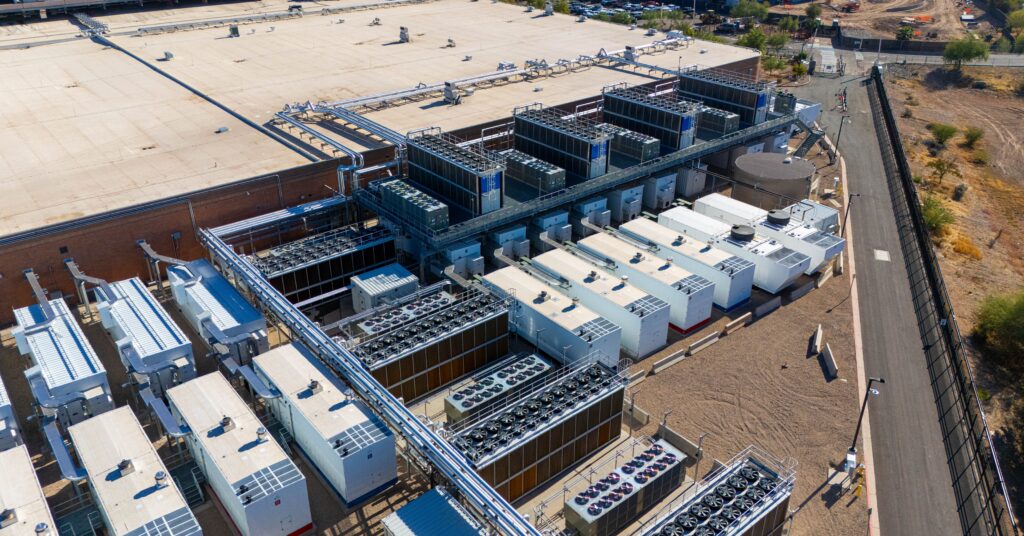
A data center campus may include server buildings, cooling equipment, backup generators and electrical substations, along with access roads and landscaped buffers. Its effects on neighboring properties depend on the arrangement of those features, the noise and light they produce and the distance separating them from homes.
Developing a data center site involves similar work to other large commercial or industrial projects. Land may need to be cleared and graded before crews begin work such as laying foundations, connecting utilities and paving access roads. A campus’s total acreage can also include buffer zones, drainage areas or space for future expansion.
The buildings’ supporting systems—such as cooling equipment, backup generators and fuel storage—also occupy space. Large campuses may also include electrical substations, which reduce the voltage of incoming electricity so that it can be safely used on-site. The scale varies considerably: CoreSite’s CH2 facility in Chicago occupies a two-acre site in an urban area, DataBank acquired an 18-acre property near Atlanta for its ATL4 facility, T5 announced a 91-acre campus in Palmetto and Google’s proposed Project Raspberry in Virginia would occupy part of a roughly 344-acre parcel.
There is also infrastructure to account for beyond property lines. Data centers need fiber-optic connections to carry information, and many projects require extensions or upgrades to nearby utility networks. New power lines, substations or water and sewer connections can require construction beyond the campus. Expanded utility capacity has been a secondary benefit of the growth of the data center industry, but just like the sites themselves, new utility corridors can also require the disturbing of nearby properties. This all means that the land use question is broader than where to put server buildings, as it also concerns the infrastructure needed to keep them operating.
Local zoning is the most apparent means of deciding where data centers belong and how they should relate to surrounding properties. Ordinances establish standards for things like building height, setbacks and equipment screening. Where a proposal requires rezoning or a special-use permit, local officials can examine its compatibility with nearby uses and consider conditions addressing the site’s particular circumstances.
These decisions involve the larger question of how communities believe land can and should be used. Zoning can address conflicts between neighboring uses, but broad restrictions (not to mention overly difficult approval processes) can also discourage development in otherwise suitable locations. Atlanta’s city council, for example, approved restrictions in 2024 prohibiting data centers within a half-mile of high-capacity transit stops. Loudoun County, Virginia, the county with the most data centers in the nation, changed its rules in 2025 to require a special exemption to approve in zoning districts where data centers had previously been allowed by right.
One of the most immediate concerns for nearby residents is noise. Fans and other cooling equipment may operate around the clock, while backup generators add noise during testing and outages.
A 2024 review by Virginia’s legislative audit agency found that most data centers did not generate noise complaints, largely because they either aren’t located close enough to residents to be a problem or have designs that limit how much sound reaches their neighbors. However, it identified at least 15 sites (about 10% of the state’s operating data center sites) where nearby residents considered the noise problematic. Noise at the facilities prompting complaints rarely exceeded local limits, so the concern was not necessarily excessive volume. However, some residents reported that its constant presence affected their well-being.
Greater separation from homes, quieter equipment and properly designed sound barriers can reduce the noise reaching neighboring properties. Sound studies before construction can identify potential problems, while testing after a facility opens can determine whether those predictions hold up. Loudoun County requires both pre-construction and post-construction noise studies, although the county acknowledges that its rules still lack standards specifically addressing tonal and low-frequency noise.
Other concerns are similar to those found in large development projects such as building size, lighting, tree removal and drainage, along with temporary construction impacts such as truck traffic, dust and noise. Setbacks and landscaping can soften visual impacts, for example, but screening a facility from view does not necessarily prevent its equipment from being heard.
The development of data centers should include clear, predictable standards that protect neighboring properties while leaving suitable locations available for development. Identifying those locations and requirements in advance gives residents a clearer understanding of what may be built nearby and developers a clearer understanding of what will be expected of them.

More Commentary
Literacy or Promise Scholarships? Georgia Doesn’t Have to Choose
The Three Constitutional Amendments on Georgia’s 2026 Ballot
To Tackle Affordability, Georgia’s Next Governor Should Start With Cutting Red Tape