

As Georgia’s legislative session enters its final week, education policy is once again taking center stage under the Gold Dome. Lawmakers are racing to move key proposals across the finish line before adjournment, with a wide range of bills advancing through the process in these final days.
Much of this year’s agenda builds on familiar themes, particularly school choice and scholarship programs. Lawmakers are revisiting and refining the Promise Scholarship, while also considering broader efforts to improve literacy, expand charter school opportunities and adjust curriculum requirements across the state.
Taken together, these proposals reflect both continuity and evolution in Georgia’s education policy priorities. As debates continue and final votes approach, the decisions made in these closing days could shape the direction of education in the state for years to come.
Read about these proposals in more detail in this week’s commentary.
– Kyle Wingfield
Friday’s Freshest 🗞️

Georgia is one of many states that has recently begun to look critically at its growing regulatory code. Lawmakers, business leaders and policy advocates have pointed out how regulations enacted by unelected bureaucrats in the executive branch have placed an unnecessary burden on the state’s workers and industries.
When it comes to cancer, time is the ultimate currency for both doctors and patients. Yet here we are in the midst of another legislative debate on whether incumbent providers, primarily hospitals, should have a “competitor’s veto” over additional access to care – even for treating cancer.
For four decades, the American regulatory state operated under a convenient, if constitutionally dubious, doctrine: that when a federal law was “ambiguous,” the tie went to the regulators. Changing this practice would require Georgia courts to decide questions of law without defaulting to an agency’s preferred interpretation.
In the running debate over Georgia’s inflated housing prices, there are the usual suspects: high interest rates, the cost of building materials, Wall Street investors. But while Georgians seek to assign blame for why “starter homes” are increasingly unattainable, a lesser known culprit remains the cost of time.
Data centers have been an integral part of energy infrastructure for much longer than they’ve been a ubiquitous topic in public policy conversations. But the rapid advance of artificial intelligence over the last few years has meant increased demand for more data centers.
Peach Picks 🍑

For years, the thousands of acres of land at the edge of the Okefenokee National Wildlife Refuge were the site of a planned titanium mine. Now, a major land purchase will turn roughly half that property into a new state wildlife management area open to the public.
Gov. Kemp announced that global biopharmaceutical giant UCB, Inc. is planning a significant investment of $2 billion in Georgia to establish its first U.S. pharmaceutical biologics manufacturing facility. The investment will generate 330 new jobs over the next several years at the Rowen Foundation’s state-of-the-art, 2,000-acre science and learning campus in Gwinnett County.
Georgia lawmakers say a bill capping property tax growth will stymie the steep increases over the past six years, but local officials worry about how they would make up the lost revenue. House Bill 1116 requires cities and counties to cap property tax increases at 3% or the rate of inflation.
Gov. Kemp on Friday suspended the state’s gas tax amid rising fuel prices as the conflict with Iran continues. The move — the first such relief offered by a U.S. state since the war started on February 28 — suspends Georgia’s tax of 33.3 cents per gallon on gas and 37.3 cents per gallon on diesel for 60 days.
The Georgia Senate voted to nearly double the tax breaks that go to donors who give to a program that pays for private school scholarships. The tax credit program for elementary, middle and high school scholarships has been capped at $120 million a year since 2023.
Under the Gold Dome 🏛️
The Foundation’s Director of Policy and Research, Chris Denson, testified before the Georgia House Health Committee in support of Senate Bill 367. The bill would remove regulatory barriers so cancer treatment centers would not need state approval to expand or open. Denson shared a story about an immunocompromised cancer patient who had to go inside hospitals for imaging while receiving treatment at UCBC. He also noted that 76 of Georgia’s 89 pediatric oncologists practice in just DeKalb and Fulton counties, leaving the rest of the state underserved. (Timestamp 1:26:25)
Featured Video 🎥
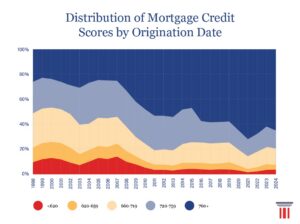
Featured Chart
In this dataset, collected by the Federal Reserve Bank of New York, we see that in 2005 home mortgage recipients with “superprime” credit scores, defined here as 760 or higher, constituted roughly 25 percent of home mortgages. Twenty years later, borrowers in this same credit tier comprise almost 65 percent of home mortgages originated.
Quote of the Week 🌟

One More Fact 💡
More than four decades ago, President Ronald Reagan helped reshape the national conversation around economic policy, emphasizing that growth and opportunity come not from expanding government, but from empowering individuals and markets.
Reagan took office during a period of high inflation, slow growth and economic uncertainty. His approach focused on lowering tax rates, reducing regulatory barriers and restoring stability through policies grounded in the belief that individuals and businesses are best positioned to make economic decisions. After a deep recession in the early 1980s, the U.S. economy entered a period of sustained expansion, with falling inflation, declining unemployment and rising investment.
The broad lesson remains clear. Government has an important role, but it is not the engine of prosperity. Its job is to create the conditions for growth — protecting property rights, enforcing the rule of law and allowing free enterprise to flourish.