
The recent Netflix miniseries Death by Lightning gave viewers a glimpse of the relatively untold story of James A. Garfield, the nation’s 20th president. His presidency, which spanned just six months in 1881, ended when he was assassinated by a deluded individual who had unsuccessfully sought appointment to his administration.
But on May 30, 1868, over a decade prior to his election as president, then-Congressman Garfield was chosen to deliver remarks at Arlington National Cemetery for the first national observance of Memorial Day (or Decoration Day, as it was known then), where his background—and heroics in Georgia—made him uniquely equipped to deliver such an address.
Garfield, who was born in 1831, spent most of his life in poverty after his father died when he was two years old. However, he would go on to become a man of many talents and professional accomplishments.
He delivered his first sermon in his early 20s and is the only U.S. president who served as a minister.
After graduating from Williams College, where he was elected to Phi Beta Kappa and named salutatorian of his class, he returned home to Ohio as a professor at Western Reserve Eclectic Institute (later Hiram College); Garfield was made its president within a year.
Feeling unfulfilled as an educator, he entered politics and was elected to the Ohio Senate in 1859 as a Republican. While serving in the state legislature, he also studied to become a lawyer. He passed the bar and was admitted to practice law in January 1861—three months before Confederate forces attacked Fort Sumter.
After the Civil War began, he received a commission as a colonel in the 42nd Ohio Infantry Regiment for the Union Army. He led Union forces at the Battle of Middle Creek and served with distinction at Shiloh and Corinth.
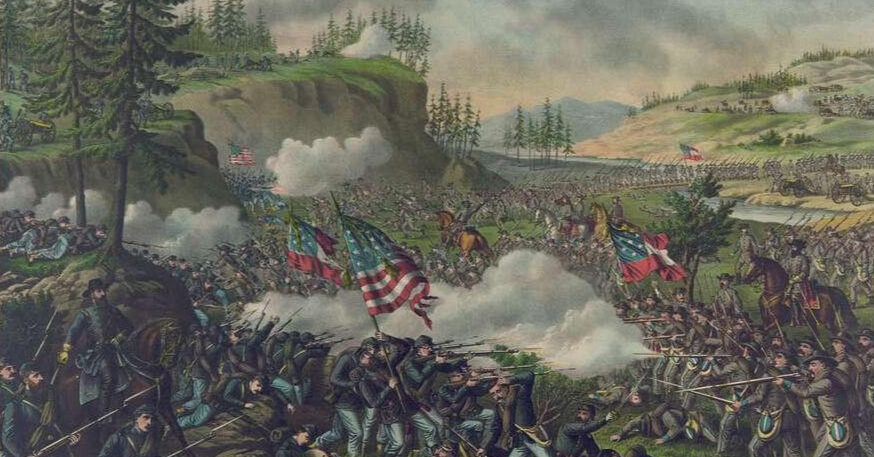
But it was the Battle of Chickamauga that would define his military career, when he voluntarily rode six miles on horseback–and through enemy lines–to inform Gen. George H. Thomas the Union Army was retreating. Upon seeing how resolutely Thomas’ men were holding their position, Garfield told the commanding officer that Thomas was “standing like a rock.” Thomas’ stand helped save the Union Army from destruction and allowed it to withdraw to Chattanooga, where Union forces would win a decisive battle two months later.
Garfield’s actions at Chickamauga led to his promotion to major general.
It was with this background that Garfield addressed 5,000 people gathered at Arlington National Cemetery. They were there to place flowers, wreaths and flags on the graves of 15,000 soldiers who died in the Civil War.
While Union soldiers filled the majority of these graves, Arlington’s Tomb of the Civil War Unknowns holds the remains of over 2,000 soldiers gathered from the fields of Bull Run and surrounding battlefields, including Confederate soldiers.
While Garfield’s entire speech is too long for this column, his opening and closing are as follows:
“I am oppressed with a sense of the impropriety of uttering words on this occasion. If silence is ever golden, it must be here beside the graves of fifteen thousand men, whose lives were more significant than speech, and whose death was a poem, the music of which can never be sung. With words we make promises, plight faith, praise virtue. Promises may not be kept; plighted faith may be broken; and vaunted virtue be only the cunning mask of vice. We do not know one promise these men made, one pledge they gave, one word they spoke; but we do know they summed up and perfected, by one supreme act, the highest virtues of men and citizens. For love of country they accepted death, and thus resolved all doubts, and made immortal their patriotism and their virtue.”
“Hither our children’s children shall come to pay their tribute of grateful homage. For this are we met to-day. By the happy suggestion of a great society, assemblies like this are gathering at this hour in every State in the Union. Thousands of soldiers are to-day turning aside in the march of life to visit the silent encampments of dead comrades who once fought by their side. From many thousand homes, whose light was put out when a soldier fell, there go forth to-day to join these solemn processions loving kindred and friends, from whose heart the shadow of grief will never be lifted till the light of the eternal world dawns upon them. And here are children, little children, to whom the war left no father but the Father above. By the most sacred right, theirs is the chief place to-day. They come with garlands to crown their victor fathers. I will delay the coronation no longer.”
The power of Garfield’s oratory would propel him to become the Republican nominee for president in 1880 after his convention speech—famously delivered on behalf of another candidate seeking the nomination. He remains the only president ever elected directly from the U.S. House of Representatives.
His speech at Arlington National Cemetery on May 30, 1868, would also help crystallize a scattering of local memorials throughout the North and South into the national observance it is today for those who died fighting on behalf of our nation.

More Commentary
To Tackle Affordability, Georgia’s Next Governor Should Start With Cutting Red Tape
Guide to the Issues 2026: Thirty years after the first edition
The Lesson Nikole Hannah-Jones Didn’t Mean to Teach