
Until recently, impact fees were believed to be immune from attacks under the Takings Clause of the United States Constitution and corresponding clauses in state constitutions, including Georgia’s. But on April 12, 2024, the United States Supreme Court held otherwise.
In Sheetz v. Eldorado County (CA)
I have pioneered impact fee principles and practice, written scores of impact fees in several states including Georgia, been an expert witness in court on impact fees, have helped write impact fee statutes—including Georgia’s, and have written six impact fee books. In this commentary, I explore implications for Georgia focusing on:
– What impact fees are, why we have them, and how they are applied in Georgia;
– Why impact fees were immune from takings claims before Sheetz;
– Why impact fees are now subject to takings claims according to the Court; and
– Implications for Georgia impact fees after Sheetz.
What impact fees are, why we have them, and how they are applied in Georgia
Impact fees are one-time charges assessed by local governments on new development to mitigate the impact of new growth and development on local public facilities. Impact fees must be proportionate to the impact imposed by new development on a given public facility, and once impact fees are collected, they must be spent in a manner that benefits feepayers reasonably. Local governments resort to impact fees when new revenues from new development are insufficient to pay for new or expanded facilities needed to serve such new growth and development. Reasons for insufficient revenue include state-imposed limits on local government finances, federal and state unfunded mandates, and an unwillingness of local voters to subsidize new development, among many others.
In 1990, Georgia became one of the first states to enable impact fees. Along with John Sibley, then of Governor Joe Frank Harris’ office, and the late Charlie Siemon, representing the development community, I co-wrote Georgia’s Development Impact Fee Act
In Georgia, local governments are authorized by the DIFA to adopt—by legislative action—impact fee ordinances. Until Sheetz, the Takings Clause was not used to challenge local impact fee ordinances. In contrast, administrative and quasi-judicial decisions have long been subject to takings claims for reasons reviewed next.
Before Sheetz, impact fees were immune from Nollan/Dolan
Three US Supreme Court cases have reigned-in the common local government practice of conditioning development permits and approvals on exactions that are not sufficiently related to mitigating the impact of development on communities.
In Nollan v. California Coastal Commission
Through Dolan v. City of Tigard (OR)
The third case is Koontz v. St. Johns River Water Management District (FL)
One thing in common with all three cases is that each required decisions outside the legislative process. Dolan in fact was a quasi-judicial process akin to a conditional use permit or variance in Georgia. Until Sheetz, Nollan/Dolan did not apply to such legislative actions as impact fee ordinances and supporting studies.
Aside from legislative immunity, there is a second reason why impact fees were presumably immune from taking claims before Sheetz: the dual rational nexus test.
Unlike Nollan and Dolan where physical property dedications were conditioned on development approval without showing essential nexus or was roughly proportionate to the impact, or Koontz which extends Nollan/Dolan to money, impact fees must (1) quantify the impacts new development has on public facilities and (2) show how impact fees mitigate those impacts in a manner the benefits feepayers. This is called the dual rational nexus test
How has Sheetz changed this?
Impact fees are now subject to takings claims
Let us first review the Sheetz case. El Dorado County, California, extends east of Sacramento to Lake Tahoe. Excluding the El Dorado National Forest which comprises above 73% of the county, its land area is about 460 square miles or about the size of Bartow County, Georgia. It is home to about 190,000 people making it less populated than Hall County, Georgia. It is also growing slowly, adding only about 10,000 people during the 2010s. Since only 30,000 people live in cities, the vast majority of the residents depend on the county for services such as roads.
The county has a Traffic Impact Mitigation (TIM) Fee Program that imposes road impact fees on new development.
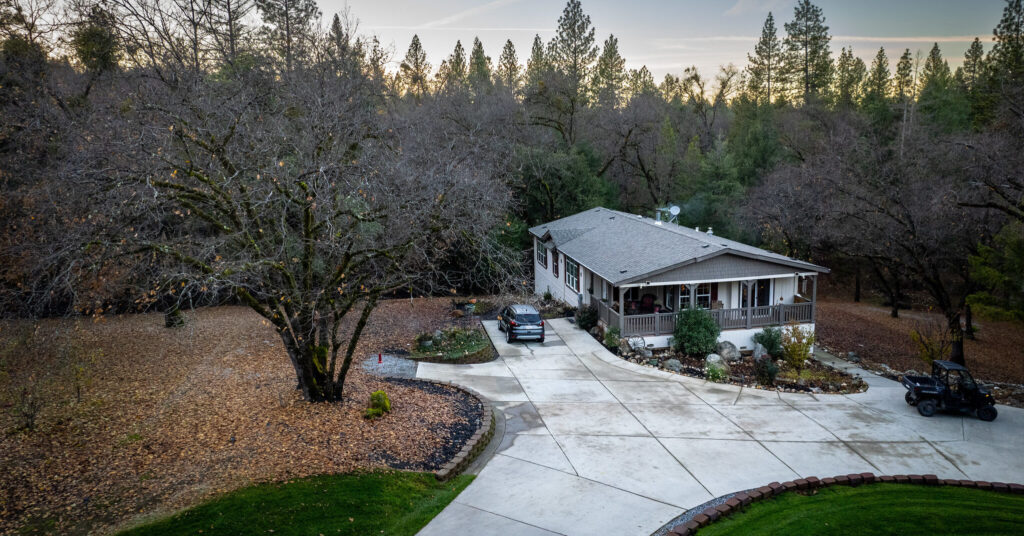
George Sheetz applied for a building permit in July 2016 to construct an 1,854-square-foot home on 9.11 acres in a rural area of the county. The county required him to pay $23,420 in road impact fees based on the type (single family) and location (the service area) of his home. No individualized determination was made to correlate the fee with the home’s specific impact on local or state roads. Sheetz paid the fee under protest and filed a legal action against the County, alleging the fee was an unconstitutional condition under Nollan/Dolan.
The Fifth Amendment to the Constitution requires that the government may not deny a benefit to a person because the person exercises a constitutional right. Pursuant to Nollan/Dolan, government may condition approval of development on the dedication of property. or payment of money pursuant to Koontz, if it can demonstrate an “essential nexus” and “rough proportionality” between the impacts of development and its mitigation through property or money.
California courts ruled against Sheetz, concluding that such legislative exactions as impact fee based on ordinances are exempt from Nollan/Dolan review. The question before the US Supreme Court focused on whether a monetary exaction imposed through a local government ordinance as a condition for a building permit is exempt from the “essential nexus” and “rough proportionality” requirements of Nollan/Dolan simply because the exaction is authorized by local legislation.
During oral argument, the county’s legal counsel conceded that legislative actions are indeed subject to takings review. Noting that all parties agreed, the Court held in favor of Sheetz unanimously. The Court instructed California’s courts to review the county’s impact fees for consistency with Nollan/Dolan. In his concurring opinion, Justice Kavanaugh, who was joined by Justices Kagan and Jackson, noted that the decision does not speak to the impact fees question directly:
I write separately to underscore that the Court has not previously decided—and today explicitly declines to decide—whether “a permit condition imposed on a class of properties must be tailored with the same degree of specificity as a permit condition that targets a particular development … Importantly, therefore, today’s decision does not address or prohibit the common government practice of imposing permit conditions, such as impact fees, on new developments through reasonable formulas or schedules that assess the impact of classes of development rather than the impact of specific parcels of property. Moreover, as is apparent from the fact that today’s decision expressly leaves the question open, no prior decision of this Court has addressed or prohibited that longstanding government practice.
What does this mean for Georgia’s impact fees?
Georgia impact fees after Sheetz
Consider the following scenario for residential impact fees which applies to many impact fee programs I have reviewed in Georgia. As in Sheetz, the context in this example is roads.
Exhibit 1: Illustrative Road Impact Fees Used in Many Georgia Communities
| Residential Project | People per Unit | Trips per Day | Cost per Trip @ | Impact Cost per Unit | Adopted Impact Fee |
| Single Family | 3.00 | 9.60 | $400 | $3,840 | $3,500 |
| Townhouse | 2.50 | 8.00 | $400 | $3,200 | $3,500 |
| Apartment | 2.00 | 6.40 | $400 | $2,560 | $3,500 |
Observe the following relationships:
– The average number of “people per unit” based on the nature of the unit is the highest for single-family detached units at 3.0 people and lowest for apartments at 2.00 people. Data for this comes from the US Census Bureau.
– The average “trips per day”, a measure of the extent of impact, varies from a high of 9.60 trips for single-family detached units to a low of 6.40 trips for apartment units. The data are available from such sources as local transportation planning agencies, the Trip Generation Manual published by the Institute of Transportation Engineers, transportation engineers, and so forth.
– The “cost per trip” is the monetary measure of the extent of project impact; it is derived from local studies.
– The “impact cost per unit” is the number of trips per unit times the cost per trip. This is the essence of proportionate share.
– The “adopted impact fee” is established through local legislation. In this case, it is the average impact cost per unit regardless of its nature or extent. The result is that single-family detached homes pay less than their proportionate share of their impact on roads while townhouses and apartments pay more. This occurs in Georgia.
Through legislative action, the foregoing would be exempt from Nollan/Dolan review. After Sheetz, however, Nollan/Dolan review applies. Indeed, going forward, all impact fees everywhere in the nation will need to abide by the following Dolan standard, edited for context:
… (local government) must make (an) individualized determination that the required dedication is related both in nature and extent to the impact of the proposed development. (Dolan at 391, emphases added.)
As a professional in planning, demographics, and economics spanning six decades, I interpret “nature” in the context of Dolan to mean the type of land use development such as office or residential while “extent” means the impact associated with the development based on its size such as square feet, acres, rooms, and so forth. Because the impact to be mitigated varies by location, the individualized determination must be based on development location.
The concepts of “individualized determination”, “nature” and “extent” are embedded in DIFA, written in 1990, several years before the Dolan. Consider definitions of two key terms in DIFA:
“Proportionate share” means that portion of the cost of system improvements which is reasonably related to the service demands and needs of the project within the defined service area.” (§ 36-71-2(16)) (Emphasis added noting that the word “the” is in the singular.)
“Project” means a particular development on an identified parcel of land. (§ 36-71-2(14)) (Emphasis added noting that the words “a” and “an” are in the singular.)
The plain language would have this apply to a particular building permit involving an individual parcel of land such as an individual lot since that is what the impact fee is on.
The word “particular” is defined in the Oxford dictionary as:
Noun: A detail. An individual item, as contrasted with a universal quality.
Origin: Late Middle English from Old French particuler, from Latin particularis ‘concerning a small part’, from particula ‘small part’. (https://www.lexico.com/en/definition/particular) (Emphases added noting the use of the singular.)
DIFA provides an additional, relevant definition:
“Development” means any construction or expansion of a building, structure, or use, any change in use of a building or structure, or any change in the use of land, any of which creates additional demand and need for public facilities. (§ 36-71-2(5)) (Emphases added noting that the word “a” is in the singular.)
In the context of DIFA, Dolan requires that impact fees must be based on individualized determinations of the nature and extent of the proportionate share impact of “a project”, “a particular development on an identified parcel of land”, and “a building or structure” on qualifying public facilities. Going forward, because of Sheetz, broad averages applied to classes of development such as residential units regardless of their type or size would violate Dolan’s requirement for individualized project-based determinations. The implication of Sheetz is that Georgia communities must redouble efforts to comply with DIFA.
Finally, and again using roads as the example, applying Dolan’s individualized determination of impact would involve determining whether a project on a particular parcel of land creates more impact on roads because of its location than another project elsewhere. This consideration gets to the heart of the second prong of the dual rational nexus test and the role of service areas. I have prepared scores of impact fees around the nation including Georgia. Except for very small towns, they all included multiple service areas. Indeed, El Dorado County differentiates impact fees for six service areas averaging about 75 square miles outside the national forest. However, most county impact fees in Georgia are based on a single service area for the entire county. In the case of roads, one can imagine situations where road impact fees used in one part of a county would rarely if ever benefit development paying those impact fees in another part of the county. Sheetz may result in the invalidation of this practice resulting in multiple service areas to help ensure proportionate share impact fees generate corresponding benefits to feepayers.
What does this mean for impact fees going forward? Pursuant to both Dolan and DIFA, Georgia’s impact fees must be based on individualized determinations that are tailored to the nature (such as type) and extent (such as size) of the proportionate share impact of a particular development on an identified parcel of land in the context of its location. Adhering closely to these standards will reduce exposure to takings claims pursuant to Sheetz.
Arthur C. Nelson is the Emeritus Professor of Urban Planning and Real Estate Development, and Geography, University of Arizona. He is a former Professor of City and Regional Planning, and Public Policy, Georgia Institute of Technology and former Adjunct Professor of Law, Georgia State University.