
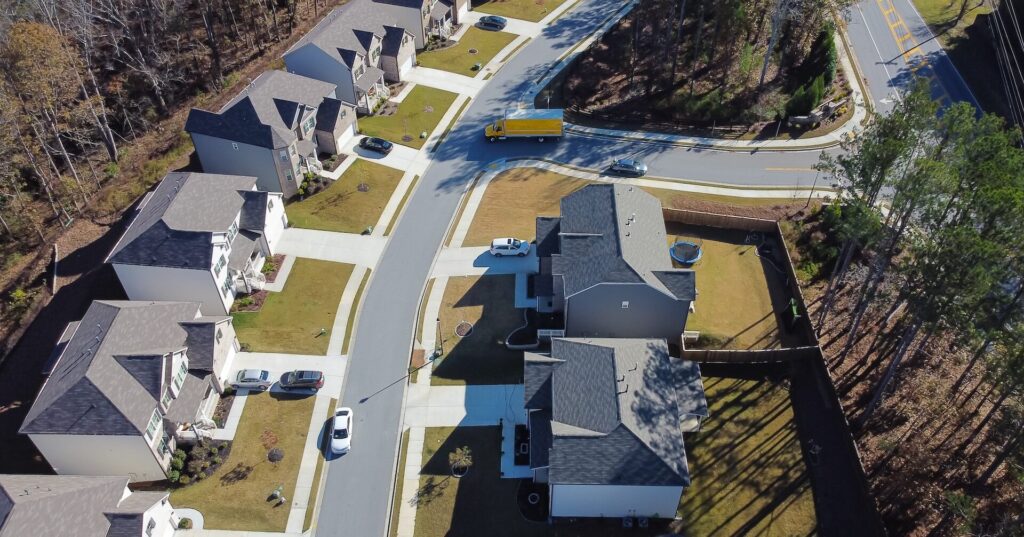
Georgia is adding people faster than it’s adding places for them to live.
Our new study, Short Supply: How Many More Homes Does Georgia Need?, finds that 94 of the state’s 159 counties face measurable housing shortages, with the average undersupplied county missing 3,879 units and the median county shortfall standing at 1,014 homes. The most acute deficit appears in Fulton County, where demand now outpaces supply by an estimated 75,152 units.
Over the past four decades, Georgia’s population growth has been nothing short of remarkable. Since 1980, each decade has seen a million new residents arrive, drawn by job opportunities, quality of life and the promise of a growing economy. Yet the state’s housing production tells a very different story. Permitting data show that while Georgia issued 829,119 residential building permits in the 2000s, that number collapsed by 52% in the 2010s, to just 397,752 permits. This dramatic decline unfolded even as the state added more than one million people between 2010 and 2020—an imbalance that now accounts for the shortage of hundreds of thousands of homes.
The collapse in permitting has a broader historical context. The Great Recession dealt a punch to Georgia’s homebuilding capacity. Between 2008 and 2013, 87 Georgia banks failed—many heavily exposed to construction and development lending—choking off financing just as construction employment plunged 30% from its 2005 peak, recovering to only 88% of its pre-recession workforce by 2019. At the same time, residential building permits collapsed by 52%, falling from 829,119 in the 2000s to 397,752 in the 2010s. That drop contributed to a statewide decline in housing units per 100 residents—from 42.21 in 2010 down to 41.18 in 2020. These capital, labor and permitting shocks—occurring even as Georgia added over a million residents each decade—left the state with a persistent, uneven shortfall in new homes.
This plunge in housing is particularly clear among single-family homes, which Americans tend to prefer. From 1980 to 2020, the state approved nearly 1.86 million single-family home permits, with Gwinnett, Fulton and Cobb Counties alone accounting for more than half a million of those approvals. But after the Great Recession, single-family construction plunged: in five years Cobb went from over 5,400 permits to just 409, Fulton from nearly 9,600 to 775, and Gwinnett from almost 9,900 to 617.
While the largest absolute shortages are concentrated in Metro Atlanta, the challenge extends far beyond the urban core. Coastal Chatham County is short by 13,424 units, Glynn by 9,945 and Clarke by 6,211 homes. Altogether, the 94 undersupplied counties account for a cumulative deficit exceeding 365,000 homes. Even in counties with smaller populations, the gap between households and available units has widened.
Regulatory and land-use policies are a recurring problem cited in the report. It details how zoning ordinances, density caps, infrastructure requirements and architectural mandates collectively slow development and raise barriers to entry. Zoning policy in many counties effectively precludes affordable “missing middle” housing options such as duplexes, triplexes, bungalow courts and townhomes.
The report highlights persistent barriers—onerous zoning rules, costly permitting processes and infrastructure mandates—that inflate construction costs, even as strong job markets, population growth and ongoing in-migration keep demand high. With the forces behind Georgia’s housing crunch expected to persist, directing attention and resources to the hardest-hit areas will be essential if the state is to close the gap between families and the homes they need.
The full county-by-county breakdown in Short Supply offers the evidence local governments can use to craft targeted pro-growth policies and meet increasing demand for housing.

More Commentary
To Tackle Affordability, Georgia’s Next Governor Should Start With Cutting Red Tape
Guide to the Issues 2026: Thirty years after the first edition
The Lesson Nikole Hannah-Jones Didn’t Mean to Teach