
When Georgia’s candidates for governor met Tuesday night for what is likely their only debate, the cost of living was never far from the conversation. Affordability has become the defining issue of this campaign, and whoever wins in November will be expected to deliver.
One driver of high costs gets far less attention than it deserves, and it sits squarely within a governor’s reach: the regulations state agencies write and enforce. Georgia’s rulebook now runs to more than 6 million words and has grown in nearly every year on record. Every rule carries a compliance cost, and those costs eventually show up in what families pay for homes, goods and services.
Lawmakers made real progress this year by ending judicial deference to state agencies and requiring them to report on the rules already on their books. The next governor can build on that with a permanent office for regulatory review, an approach Virginia’s previous administration credited with an estimated $1.2 billion in annual savings. Cutting red tape shouldn’t be a partisan cause.
With early voting starting Tuesday, here’s a question worth asking every candidate: What will you do about red tape?
Read more about the next governor’s opportunity in this week’s commentary.
– Kyle Wingfield
Friday’s Freshest 🗞️

As data centers drive up electricity demand, Georgia needs to make sure households and other businesses aren’t left paying for the infrastructure those facilities require. Communities also deserve to know how much power these facilities actually use.
Georgia Pathways, the state’s alternative to full Medicaid expansion, is set to expire at the end of 2026, leaving the next governor with a major decision. Our new policy brief explains who Medicaid covers today, how recent federal changes affect the program and what expansion would cost the state.
Georgia voters will choose a new governor, lieutenant governor and every state legislator this November, and many of those officials will face issues beyond the platforms that got them elected. The Foundation’s 2026 Guide to the Issues, marking 30 years since the first edition, offers recommendations on nine key issues for new leaders and voters alike.
An eye-opening recent essay in The New York Times Magazine offers proof of the power of choice, particularly for education.
Peach Picks 🍑

International companies pledged $7.8 billion in new investment and 9,350 jobs in Georgia during the fiscal year that ended in June, doubling the prior year’s total. Overall, the state’s economic development projects accounted for $35.2 billion in announced investment and 25,300 new jobs, though most are multi-year commitments that will take time to fully materialize.
Democrat Keisha Lance Bottoms and Republican Rick Jackson met Tuesday night in what is likely their only debate before Election Day. Voters asked about everything from healthcare to privacy, and the candidates found common ground on a few issues, including cutting taxes and raising teacher pay.
Gov. Kemp announced that Hyundai Transys will invest nearly $560 million to expand its manufacturing capabilities in West Point, Georgia. The company plans to create 320 new jobs as part of its ongoing efforts to support global automotive customers with operations in North America.
Georgia’s public school class of 2026 posted a mean SAT score of 1031, up two points from the previous year. The share of students taking the test climbed from 55% to 59%; math improved by four points while reading and writing dipped by one.
Featured Chart📊
The Georgia Public Policy Foundation’s goal for this Guide to the Issues is to provide a compilation of commonsense policies upon which Georgia’s elected officials can base laws, ordinances, rules and regulations without fear of partisan influence. The policies proposed are based on facts and the principles of limited government, individual responsibility and free enterprise. They support an approach that reinforces policy over politics.
Quote of the Week 🌟
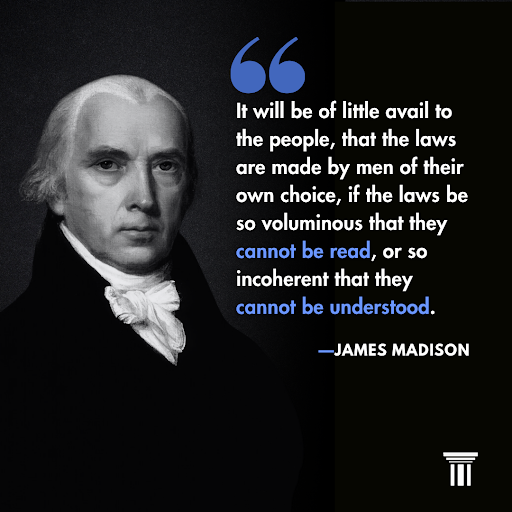
James Madison wrote these words to defend the structure of the new Constitution, but his warning is just as relevant to state government today. Voters choose who writes the laws, and that choice is supposed to give them a say in how they are governed.
That promise weakens when the rules pile up faster than anyone can read them. Much of the law that shapes daily life now comes not from elected legislators but from agency regulations, which most citizens never see until they are asked to comply.
Self-government depends on laws that ordinary people can know and understand. A shorter, clearer rulebook that is reviewed regularly is one of the simplest ways a republic keeps faith with the people it governs.

More Commentary
To Tackle Affordability, Georgia’s Next Governor Should Start With Cutting Red Tape
Guide to the Issues 2026: Thirty years after the first edition
The Lesson Nikole Hannah-Jones Didn’t Mean to Teach