
For more than a century, races for the Supreme Court of Georgia barely registered with voters. Incumbents rarely faced challengers, and they almost never lost—you have to go back to 1922 to find a sitting justice voted off the state’s highest court.
The 2026 election shattered that quiet tradition. A roughly $8 million Democratic push set out to unseat two incumbent justices, in a contest that featured dueling endorsements from Barack Obama and Brian Kemp and even drew a warning from the Judicial Qualifications Commission—all in a judicial system that has been officially nonpartisan since 1983.
But beneath the campaign drama lies a more fundamental question: do we really want justices who treat the bench as a place to legislate? Turning the judiciary into a partisan battleground erodes the separation of powers that holds our constitutional republic together.
We take a look at what Georgia’s 2026 judicial races reveal—and what’s at stake if the trend continues in this week’s commentary.
– Kyle Wingfield
Friday’s Freshest 🗞️

Gov. Kemp signed legislation that will streamline Georgia’s building permit process. Senate Bill 447, authored by Sen. Clint Dixon (R-Gwinnett), is designed to tighten Georgia’s existing 45-day timeframe for local governments to review building permit applications and to create clear application criteria for all parties involved, both local governments and developers.
On the governor’s final day to sign or veto legislation from this year’s session, the long wait for legislators and lobbyists finally ended. Just not in the way many would have hoped. Then, before the ink was even dry on the session’s final documents, Gov. Brian Kemp announced a special legislative session to convene on June 17.
Every year, thousands of Georgia parents fill out lottery applications for schools their children may never get to attend. Not because they can’t afford it, but because thousands of other Georgia families want the same thing and there simply aren’t enough seats. That school is a public charter school.
This year’s session was dominated by a pair of tax debates: one over income taxes and one concerning property taxes. The opposition to each plan featured the common complaint that each amounted to “cutting” revenues–i.e., the ability to spend more taxpayer dollars–year over year well into the future. Only in Washington, D.C., could anyone believe that was true.
Peach Picks 🍑

Three weeks before Georgians return to the polls, candidates are swiping barbs and announcing new endorsements. Republicans have two important races to decide on June 16. Lt. Gov. Burt Jones and businessman Rick Jackson topped a crowded field last week to advance to the gubernatorial runoff.
Days away from the FIFA World Cup kicking off in Atlanta, MARTA’s new trains have not yet passed critical safety tests — a delay that threatens to undermine the agency’s promise to upgrade the transit system in time for the city’s showcase on the international stage. It’s the latest setback in a $707 million project that’s already led to finger-pointing behind the scenes as the transit agency struggles to bring its first new railcars in more than two decades into service.
Atlanta is parked among the top 10 worst metropolitan areas for traffic in the U.S., according to a new study by Consumer Affairs. The consumer research-based website analyzed data from the nation’s 50 most populous areas, including factors such as daily hours of congestion, average commute times and fatal car crash rates.
The policies that Georgia uses to approve or deny services for children enrolled in Medicaid fail to satisfy federal requirements for adequate care, according to a new federal court ruling. A three-judge panel of the U.S. Court of Appeals for the Eleventh Circuit upheld a federal district judge’s order requiring the Georgia Department of Community Health (DCH) to provide nearly five times more in-home nursing care to a child at risk of dying than the state had approved through a contractor.
The Georgia Ports Authority has been on track to launch a major boost to its rail capabilities. That initiative launched this month with the opening of the Gainesville Inland Port.
In the Media 📺
Our Memorial Day commentary by Chris Denson, the Foundation’s Director of Policy and Research, was republished this week by the Coastal Courier. In the piece, Denson explores how future President James Garfield’s heroics at the Battle of Chickamauga — and his later Arlington address honoring fallen soldiers — helped shape what became Memorial Day.
Quote of the Week 🌟
One More Fact 💡
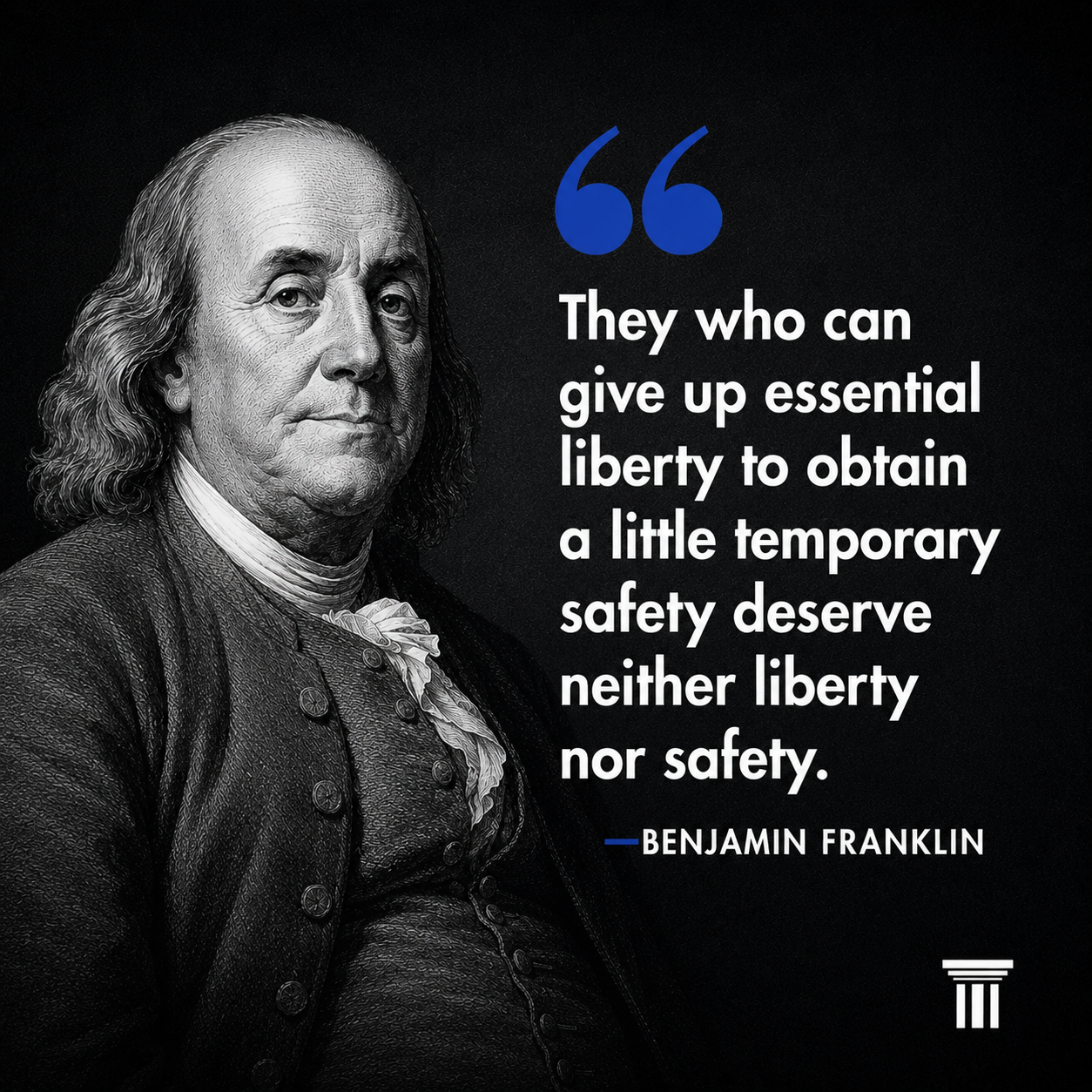
More than 250 years later, Benjamin Franklin’s warning not to give up essential liberty still resonates. Every legislative session brings new proposals promising security, stability or convenience — often at the cost of personal freedom, economic opportunity or local control. While good intentions matter, policy should ultimately be judged by results and by whether it strengthens or weakens the ability of Georgians to make decisions for themselves.
That’s why we continue to emphasize the importance of limited government, free enterprise and individual liberty. Whether the issue is taxes, education, healthcare, housing or occupational licensing, the underlying question remains the same: Are we empowering citizens, families and communities, or concentrating more power in government institutions?
Georgia has often led the way by embracing policies that trust people over bureaucracy. Lower taxes, regulatory reform and expanded educational opportunities have helped make the state a destination for families and businesses alike.
Franklin understood that freedom requires vigilance. Preserving liberty is rarely the easiest path in the moment — but history suggests it is the one most likely to produce lasting prosperity and human flourishing.

More Commentary
The Three Constitutional Amendments on Georgia’s 2026 Ballot
To Tackle Affordability, Georgia’s Next Governor Should Start With Cutting Red Tape
Guide to the Issues 2026: Thirty years after the first edition