
While the early hours of April 3 marked the official adjournment of the 2026 legislative session, its true coda took place this week. On the governor’s final day to sign or veto legislation, the long wait for legislators and lobbyists finally ended. Just not in the way many would have hoped.
Then, before the ink was even dry on the session’s final documents, Gov. Brian Kemp announced a special legislative session to convene on June 17.
We break down the reasons why in this week’s commentary.
– Kyle Wingfield
Friday’s Freshest 🗞️

Every year, thousands of Georgia parents fill out lottery applications for schools their children may never get to attend. Not because they can’t afford it, but because thousands of other Georgia families want the same thing and there simply aren’t enough seats. That school is a public charter school.
This year’s session was dominated by a pair of tax debates: one over income taxes and one concerning property taxes. The opposition to each plan featured the common complaint that each amounted to “cutting” revenues–i.e., the ability to spend more taxpayer dollars–year over year well into the future. Only in Washington, D.C., could anyone believe that was true.
While a great deal of focus on education policy in Georgia has revolved around school choice policies and education finance, there are significant changes taking place inside the classroom as well. Georgia has joined several states in addressing early literacy, that fundamental period for students that typically begins around age 5.
With most Americans recently submitting their income tax filings, it’s an opportune time to review where exactly those tax dollars go in the federal budget these days. Spoiler: It’s mostly going to our entitlement programs, Social Security, Medicare and Medicaid. But what should also be alarming is how much tax revenue is being used at this point just to pay interest on the national debt.
Ronald Reagan reportedly once observed to his chief of staff James Baker, “I’d rather get 80% of what I want than go over the cliff with my flags flying.” But with the business of the General Assembly likely concluded until 2027, the 2026 legislative session may be defined by its missed opportunities, both in the final version of the bills passed and in those that didn’t make it across the finish line.
Peach Picks 🍑

On Monday, Gov. Kemp signed multiple bills into law in an effort to support the state’s economy and reduce the tax burden. Among them, HB 463 lowers Georgia’s income tax rate from 5.19% to 4.99% immediately and to 3.99% eventually, while SB 33 creates a new local sales tax option designed to provide property tax relief for homeowners.
Gov. Kemp also signed seven workforce-related bills Monday, including measures to streamline professional licensing and reorganize Georgia’s workforce development strategy. The package includes HB 1254, which moves regulation of several professions from standalone boards to the Secretary of State, and SB 553, which creates clearer licensure pathways for certain construction trades.
On Tuesday, Gov. Kemp signed the state budget for Fiscal Year 2027. Kemp ordered state agencies to withhold more than $300 million in proposed new spending as the state adjusts to the fiscal impact of recently enacted tax cuts.
On Wednesday, Gov. Kemp signed a proclamation convening the Georgia General Assembly for a special session on June 17 to address redistricting in the wake of a landmark U.S. Supreme Court ruling expected to require changes to Georgia’s electoral maps before the 2028 election cycle. The special session comes six weeks after the Supreme Court issued its 6-3 ruling in Louisiana v. Callais on April 29, 2026, finding that Louisiana’s second majority-Black congressional district relied too heavily on race in its construction and was therefore an unconstitutional gerrymander.
Two Georgia wildfires that have been raging for weeks are both 90% contained, fire officials said. The Pineland Road Fire, which has burned 32,575 acres since it began on April 18, is 90% contained, the Georgia Forestry Commission said on Thursday.
In the Media 📺
The Foundation’s Policy Director, Chris Denson, was interviewed for a piece featured on Yahoo News about Democrats’ renewed push to expand Medicaid in Georgia. Denson cautioned that full expansion would not solve the state’s provider-access challenges and could shift some Georgians from private coverage into Medicaid.
The Goldwater Institute highlighted Georgia’s new law ending judicial deference to state agencies, calling HB 1247 an important separation-of-powers reform.The piece also credited the Georgia Public Policy Foundation, along with AFP–GA, for helping secure the measure’s passage.
Quote of the Week 🌟
One More Fact 💡
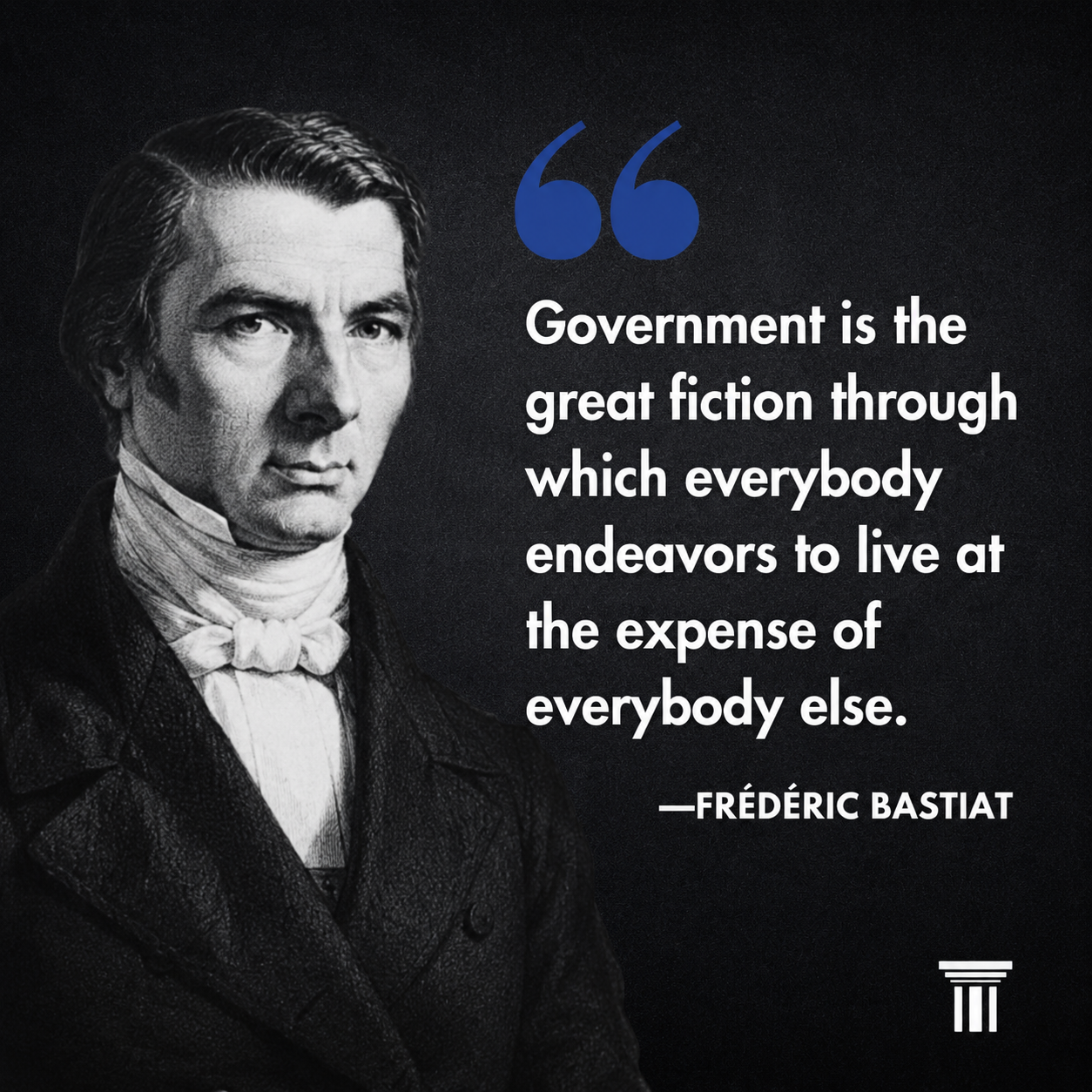
Nearly two centuries ago, French economist Frédéric Bastiat warned that government can become “the great fiction through which everybody endeavors to live at the expense of everybody else.” His point was not that government has no legitimate role, but that it cannot create prosperity simply by shifting resources from one group to another.
Every subsidy, special exemption, mandate or protectionist policy carries a cost. It may be hidden, delayed or spread across millions of taxpayers and consumers, but it is still real. When government is treated as a source of benefits detached from those costs, politics becomes a scramble for favors, with each group hoping to gain more than it gives up.
That warning remains relevant today.
Sound public policy asks not only who benefits from a proposal, but who pays, what incentives it creates and whether it expands opportunity for everyone rather than carving out advantages for a few. Government works best when it protects the conditions for families, workers and entrepreneurs to flourish — instead of trying to manufacture prosperity through redistribution, favoritism or debt.
More Commentary
Literacy or Promise Scholarships? Georgia Doesn’t Have to Choose
The Three Constitutional Amendments on Georgia’s 2026 Ballot
To Tackle Affordability, Georgia’s Next Governor Should Start With Cutting Red Tape