
With most Americans recently submitting their income tax filings, it’s an opportune time to review where exactly those tax dollars go in the federal budget these days.
Spoiler: It’s mostly going to our entitlement programs, such as Social Security, Medicare and Medicaid. But what should also be alarming is how much tax revenue is being used at this point just to pay interest on the national debt.
We take a closer look at where federal tax dollars go and why the math in Washington keeps getting harder to ignore in this week’s commentary.
– Kyle Wingfield
Friday’s Freshest 🗞️

Ronald Reagan reportedly once observed to his chief of staff James Baker, “I’d rather get 80% of what I want than go over the cliff with my flags flying.” But with the business of the General Assembly likely concluded until 2027, the 2026 legislative session may be defined by its missed opportunities, both in the final version of the bills passed and in those that didn’t make it across the finish line.
If you’ve spent any time scrolling through social media or watching the evening news lately, you’ve likely heard a familiar villain blamed for the skyrocketing cost of housing in Georgia: the “institutional investor.” But if housing affordability is one of your concerns, the “investor” issue is a distraction.
Georgia is one of many states that has recently begun to look critically at its growing regulatory code. Lawmakers, business leaders and policy advocates have pointed out how regulations enacted by unelected bureaucrats in the executive branch have placed an unnecessary burden on the state’s workers and industries.
For four decades, the American regulatory state operated under a convenient, if constitutionally dubious, doctrine: When a federal law was “ambiguous,” the tie went to the regulators. Changing this practice would require Georgia courts to decide questions of law without defaulting to an agency’s preferred interpretation.
In the ongoing debate over Georgia’s inflated housing prices, there are the usual suspects: high interest rates, the cost of building materials and Wall Street investors. But while Georgians seek to assign blame for why “starter homes” are increasingly unattainable, a lesser-known culprit remains the cost of time.
Peach Picks 🍑

Georgia ranks 14th nationally for economic outlook and 10th for economic performance in the 2026 Rich States, Poor States rankings, reflecting a relatively strong competitive position overall. The report also highlights several pro-growth factors in Georgia’s policy environment, including its right-to-work status, the absence of an estate or inheritance tax and recent legislated tax changes that rank first nationally.
Gov. Kemp today announced that Prime, Inc., a leading North American transportation company, will invest more than $160 million to establish a new Southeastern regional hub in Spalding County. The new facility will create more than 120 new full-time jobs in addition to hiring more than 50 professional drivers.
All five of metro Atlanta’s core counties had net out-migration in 2023, led by DeKalb County’s loss of 7,593 residents. The largest county loss as a percentage of population was tiny Chattahoochee County in southwest Georgia, at 2.21%, according to data compiled by Andrey Yushkov of the University of Illinois Chicago. The largest gains were in Jackson County (3,793) and Dawson County (6.2%). Overall, Georgia had net in-migration of 35,536, or 0.46%. These figures do not account for births and deaths and therefore do not represent total population gains or losses.
Georgia residents attending the state’s public colleges and universities will pay 1% more in tuition in the 2026-27 year. The Board of Regents also agreed to a 3% increase for out-of-state students.
Hartsfield-Jackson Atlanta International Airport was again the world’s busiest airport in 2025 with 106.3 million passengers. That’s according to preliminary data from industry group Airports Council International World released Tuesday.
In the Media 🎤
Foundation Analyst J. Thomas Perdue’s article, “The Fight Against Red Tape Continues in Georgia,” was republished by the Foundation for Economic Education (FEE), expanding its reach to a broader national audience. The piece highlights several Georgia reform efforts aimed at curbing administrative overreach, strengthening legislative oversight of agency rules and reducing the burden of outdated or excessive regulations.
Featured Video 🎥
Quote of the Week 🌟
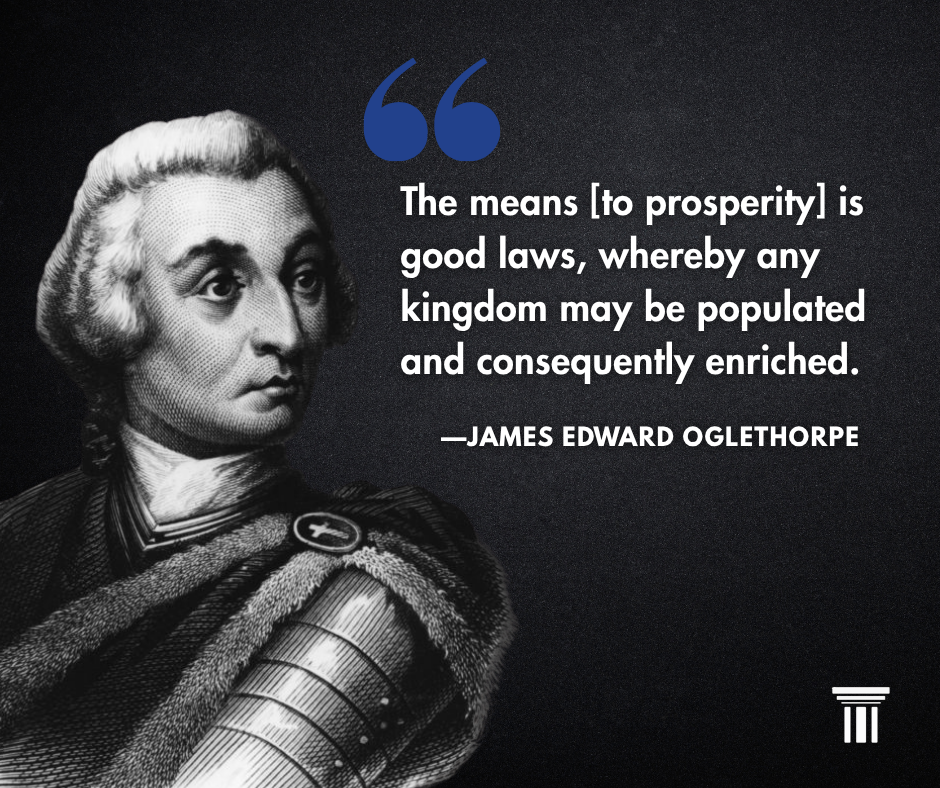
One More Fact 💡
As the United States marks its 250th anniversary in 2026, Georgia’s own story reminds us that the roots of the American experiment stretch back well before the Declaration of Independence.
Founded in 1733 as the last of the original 13 colonies, Georgia began with James Edward Oglethorpe’s settlement at Savannah under a charter granted by King George II to a board of Trustees. The colony’s founding had several purposes: It was meant to provide a new start for the poor, strengthen Britain’s economic foothold in North America and serve as a buffer between British South Carolina and Spanish Florida. Although Georgia is often casually described as a colony for debtors, historians generally note that this description is too simplistic; its founding was also deeply tied to military strategy, philanthropy and economic ambition.
In its early years, Georgia was governed by the Trustees rather than by a royal governor. The Trustees imposed rules they believed would promote a stable and virtuous society, including restrictions on slavery, liquor and large landholdings. Over time, many colonists pushed back against those limits, and in 1752 Georgia became a royal colony under direct British control.
During the Revolutionary era, Georgia was not always as quick as some other colonies to break with Britain, but it ultimately joined the cause for independence, adopted its first state constitution in 1777 and ratified the U.S. Constitution on January 2, 1788, becoming the fourth state to enter the Union. From a carefully planned frontier outpost, Georgia grew into a full-fledged state with an important place in the history of the South and the nation.

More Commentary
The Three Constitutional Amendments on Georgia’s 2026 Ballot
To Tackle Affordability, Georgia’s Next Governor Should Start With Cutting Red Tape
Guide to the Issues 2026: Thirty years after the first edition