
Mexico memorializes a church bell’s call to arms. France honors the storming of a notorious political prison. India marks the day its sovereignty took effect. South Korea, its liberation when Japan’s surrender brought World War II to an end.
As America celebrates our Independence Day for the 250th time, it is worth recalling why our national holiday falls on the day it does.
Why the Fourth of July, and not the 16th of December – the date of the Boston Tea Party? Following the short-lived Stamp Act and preceding the Intolerable Acts, it was a key moment in the colonists’ transformation from aggrieved Englishmen to revolutionary Americans.
Why the Fourth of July, and not the 19th of April – the date of the Battles of Lexington and Concord? These ensued from the midnight ride of Paul Revere and featured the first hostilities of the Revolutionary War, including the legendary “shot heard round the world.”
Why the Fourth of July, and not the 19th of October – the date of Cornwallis’ surrender at Yorktown? Or the Third of September – the date when the British and Americans signed the Treaty of Paris nearly two years later?
After years of war against the great power of that era, our national holiday doesn’t mark a military victory. As part of an experiment in self-governance that yielded the most ingenious Constitution yet devised, it does not commemorate the creation of our new nation’s government.
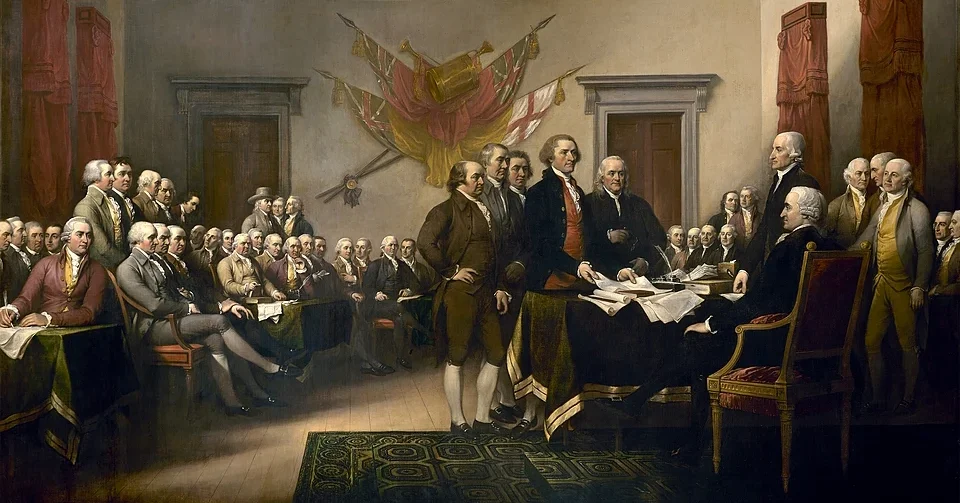
The Fourth is about a declaration, because the Fourth is about the Declaration.
The Declaration of Independence was the most revolutionary act of our revolutionary generation. Not because the document’s signers risked everything by doing so, though they did. Not because it opened a new epoch, though it did. But rather, because it sparked a change in human thought, behavior and expectations that continues to unfold 250 years later.
The Constitution is our national instruction manual. In Lincoln’s greatest speeches we find the renewal of our national vows. “I Have a Dream” is the voice of our national conscience.
The Declaration informed them all, because it explains our national ideal in its earliest, purest and most radical form.
The truths it lays out – that all men are created equal, that they are endowed by their Creator with certain unalienable Rights – were far from self-evident then, and have yet to reach global acceptance today.
The rights it specifies – Life, Liberty and the pursuit of Happiness – remain the subject of debate even now.
The purpose and origin it ascribes to the just powers of government – to secure these rights, with the consent of the governed – ran counter to an Age of Absolutism which had held sway over Europe for nearly two centuries. As did its remedy when a Government becomes destructive of these ends: to alter or to abolish it, and to institute new Government.
Alongside these radical ideas, the Declaration offers an inherently conservative caution: Governments long established should not be changed for light and transient causes. Then it submits to a candid world more than two dozen grievances that merit dissolution from Britain, recalls the repeated Petitions for Redress that were answered only by repeated injury, and asks the Supreme Judge of the world to weigh its signers’ intentions.
For Americans, everything is there: the ideals, the political theory, the appeal to evidence, the supplication to a higher power.
The Declaration is not sufficient for the governance of a free people, but it is indispensable to the governance of our people.
We may disagree about constitutional rights and the separation of powers, about the balance struck between the federal government and the states, about the line between any level of government and civil society. The Founders engaged in these very debates.
But in those arguments – and in all the rancor that marks our present age, like many moments of our history since the Fourth – let us return always to the Declaration: our declaration of who we are and when we began to be.

More Commentary
The Three Constitutional Amendments on Georgia’s 2026 Ballot
To Tackle Affordability, Georgia’s Next Governor Should Start With Cutting Red Tape
Guide to the Issues 2026: Thirty years after the first edition