
Georgia is one of many states that has recently begun to look critically at its growing regulatory code.
Lawmakers, business leaders and policy advocates have pointed out how regulations enacted by unelected bureaucrats in the executive branch have placed an unnecessary burden on the state’s workers and industries. The lack of legislative oversight in what functions as de facto lawmaking (this is especially true at the federal level) is another concern. This problem is compounded by the fact that Georgia’s code has grown unchecked for decades, resulting in a lack of transparency as well as redundant, outdated and even contradictory rules.
But as the state’s code grows, so too does the list of other states that have taken steps to reduce their own. Those efforts demonstrate a widespread shift away from passive acceptance of regulatory growth. Despite lawmakers’ desire to maintain Georgia’s status as “the best state for business,” the push for meaningful regulatory reform has not been free of obstacles.
At the beginning of 2025, the first year of Georgia’s current two-year legislative session, the lieutenant governor’s office sent a clear signal that the state was getting serious about regulatory reform with the announcement of the Red Tape Rollback Act. This resulted in Senate Bill 28, introduced by Sen. Greg Dolezal. It was an omnibus package that bundled together several ideas seen in other states that have proved more effective and enduring.
It would have required small-business impact analyses for bills, added stronger economic impact analysis requirements for agency rules, expanded the General Assembly’s ability to object to or override proposed rules and required periodic review and sunset of administrative rules so agencies would have to justify keeping them on the books. Despite passing the Senate last year, SB 28 was not brought up for a vote in the House and has not advanced this year.
Despite this, regulatory reform is still very much alive at the Capitol. Instead of one sweeping package, lawmakers have moved a series of smaller, targeted fixes.
Read more in this week’s commentary.
– Kyle Wingfield
Friday’s Freshest 🗞️

When it comes to cancer, time is the ultimate currency for both doctors and patients. Yet here we are in the midst of another legislative debate on whether incumbent providers, primarily hospitals, should have a “competitor’s veto” over additional access to care – even for treating cancer.
For four decades, the American regulatory state operated under a convenient, if constitutionally dubious, doctrine: that when a federal law was “ambiguous,” the tie went to the regulators. Changing this practice would require Georgia courts to decide questions of law without defaulting to an agency’s preferred interpretation.
In the running debate over Georgia’s inflated housing prices, there are the usual suspects: high interest rates, the cost of building materials, Wall Street investors. But while Georgians seek to assign blame for why “starter homes” are increasingly unattainable, a lesser known culprit remains the cost of time.
Data centers have been an integral part of energy infrastructure for much longer than they’ve been a ubiquitous topic in public policy conversations. But the rapid advance of artificial intelligence over the last few years has meant increased demand for more data centers.
Peach Picks 🍑

The Georgia Senate on Thursday passed a bill to suspend the state’s motor fuel tax for 60 days amid skyrocketing gas prices following rising tensions in the Middle East. Gov. Kemp plans to sign it today, though it will take a few days to kick in because the fuel tax is charged at the distributor level, not by gas stations.
Gov. Kemp announced that Glytec, a major health tech company, will relocate its headquarters to Cobb County, adding 500 new jobs over the next several years. “Georgia’s skilled workforce and business-friendly approach have fostered success for global healthcare technologies like Glytec, making the Peach State an international hub of innovation and growth in this field,” he said.
The Georgia Senate gave final passage to a measure providing up to $500 in income tax rebates to Georgians who filed state income tax returns in both 2025 and 2024. HB 1000, sponsored by Cartersville Republican state Rep. Matthew Gambill, passed the Senate Monday with a 53-0 vote.
A city in Georgia cut off water access to the site of a planned ICE detention “mega center” and is refusing to lift the block until the agency can properly detail the facility’s daily needs. Social Circle placed a lock on the water meter connecting to a massive warehouse on Hightower Trail that the Department of Homeland Security plans to use to house up to 10,000 detained migrants.
A year after the Georgia General Assembly passed a bill banning personal cellphones and two-way electronic devices in grades K-8, a bill that would ban them in high schools is poised for passage. House Bill 1009 was approved 145-20 by the House of Representatives on Feb. 24. The Senate Children and Families Committee agreed to advance it on Tuesday after a short hearing.
Featured Video 🎥
Featured Report
Our Short Supply report describes consistent problems that hinder the production of affordable housing, as well as trends that contribute to the high demand that influences a shortage.

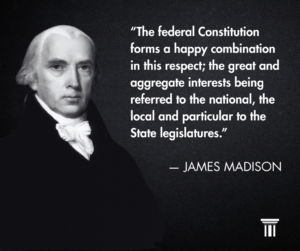
Quote of the Week 🌟
One More Fact 💡
James Madison’s Federalist No. 10 remains one of the most important explanations of how a free society can manage political conflict without sacrificing liberty. Writing in defense of the Constitution, Madison warned about the dangers of factions—groups of citizens united by interests or passions that may run contrary to the rights of others or the broader public good.
Madison recognized that factions are inevitable in a free society. People have different talents, resources and viewpoints, and those differences naturally lead to competing interests. Rather than attempting to eliminate factions—something he believed would require destroying liberty itself—Madison argued that the better solution was to design institutions that prevent any single faction from dominating the rest.
His solution was a large republic with representative government. By expanding the political sphere and allowing many interests to compete, the system makes it harder for narrow groups to capture power. Representation also filters public opinion through elected officials who must consider the broader interests of their constituents.
This insight still resonates today. Good governance depends on institutions that disperse power, encourage open debate and prevent concentrated interests from dominating the policymaking process. Policies that promote transparency, accountability and competition help ensure that government serves the public rather than a narrow set of insiders—an idea Madison understood more than two centuries ago.