
Ronald Reagan reportedly once observed to his chief of staff James Baker, “I’d rather get 80% of what I want than go over the cliff with my flags flying.”
But with the business of the General Assembly likely concluded until 2027, the 2026 legislative session may be defined by its missed opportunities – both in the final versions of the bills passed and in those which didn’t make it across the finish line.
With forty legislative days now behind us – and a state budget sent to the governor’s desk – we can begin to assess how things fared now that the state legislature has adjourned.
Read our breakdown of the 2026 session in this week’s commentary.
– Kyle Wingfield
Friday’s Freshest 🗞️

If you’ve spent any time scrolling through social media or watching the evening news lately, you’ve likely heard a familiar villain blamed for the skyrocketing cost of housing in Georgia: the “institutional investor.” But if housing affordability is one of your concerns, the “investor” issue is a distraction.
Georgia is one of many states that has recently begun to look critically at its growing regulatory code. Lawmakers, business leaders and policy advocates have pointed out how regulations enacted by unelected bureaucrats in the executive branch have placed an unnecessary burden on the state’s workers and industries.
For four decades, the American regulatory state operated under a convenient, if constitutionally dubious, doctrine: When a federal law was “ambiguous,” the tie went to the regulators. Changing this practice would require Georgia courts to decide questions of law without defaulting to an agency’s preferred interpretation.
In the ongoing debate over Georgia’s inflated housing prices, there are the usual suspects: high interest rates, the cost of building materials, Wall Street investors. But while Georgians seek to assign blame for why “starter homes” are increasingly unattainable, a lesser-known culprit remains the cost of time.
Peach Picks 🍑

The State of Georgia’s net tax collections in the month of March totaled $2.62 billion, for an increase of $120.4 million, or 4.8%, compared to March 2025, when net tax collections totaled $2.5 billion for the month. Year-to-date, net tax revenue collections through three quarters totaled $24.5 billion, an increase of 463.6 million, or 1.9%, compared to the same pointFY 2025, when net tax collections totaled roughly $24.04 billion.
Georgia’s 2026 legislative session has come to a close, but all bills passed by state lawmakers this year have one final hurdle to clear before they can take effect: They must be signed into law by Gov. Kemp. Kemp has 40 days after the Legislature adjourns to sign or veto the measures passed by state lawmakers this session.
Georgia received high marks for the condition of its highways but low marks for traffic conditions in urban areas, according to a report from the Reason Foundation. Georgia ranked second overall for roads and fifth for structurally deficient bridges.
The Georgia General Assembly ended its annual session early Friday without a plan for new equipment to overhaul the state’s voting system by a July deadline, casting doubt on the future of elections in the political battleground.The lawmakers’ failure to offer a solution after months of debate raises uncertainty about how Georgians will vote in November and leaves confusion that could end in the courts or a special legislative session.
When the General Assembly convened in January to begin its legislative session, few issues seemed to get more attention from lawmakers than data centers. But as the legislature adjourned in the wee hours of Friday morning, the robust debate that began beneath the Gold Dome earlier this year ended in relative silence, at least as far as data centers are concerned.
Sky Valley city council members officially voted to rescind combined $5 million in grant funding from two different grants for the municipality’s proposed sewer project.
In the Media 🎤
The Atlanta Journal-Constitution interviewed Foundation President Kyle Wingfield for a story on the tax relief measures passed in the final days of Georgia’s legislative session. In the article, Kyle welcomed lawmakers’ gradual approach to reducing the state income tax rate and noted that Georgia has already moved from a 6% rate to 5.19%, with a path now toward 4%.
Featured Video 🎥
Quote of the Week 🌟
One More Fact 💡
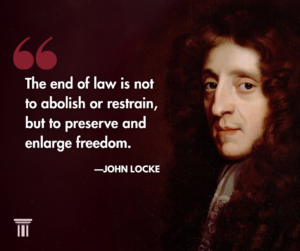
John Locke remains one of the clearest and most influential defenders of free government ever to write. He argued that individuals possess natural rights—not because government grants them, but because they belong to human beings by nature. Among these rights, Locke especially emphasized life, liberty and property. In his view, the legitimate purpose of government is not to control every aspect of life, but to secure those rights and administer justice fairly.
That principle still matters today. A free society depends on limits—limits on what government may take, regulate, command or centralize. When public officials forget those limits, citizens are no longer treated as free people with rights of their own, but as subjects to be managed. Locke rejected that view. He believed political authority is just only when it rests on consent and serves the common good by protecting freedom under law.
For those who care about opportunity, constitutional government and human flourishing, Locke’s thought remains indispensable. He reminds us that the state exists for the person—not the person for the state—and that liberty, responsibility and property are inseparable foundations of a healthy society.
More Commentary
In Recognition of Tax Day: Why Congress Avoids the Hardest Math in Washington
Political Ambition Meets Legislative Gravity: Georgia’s 2026 Session
Georgia won’t lower cost of housing until state tackles the ‘regulatory tax’