
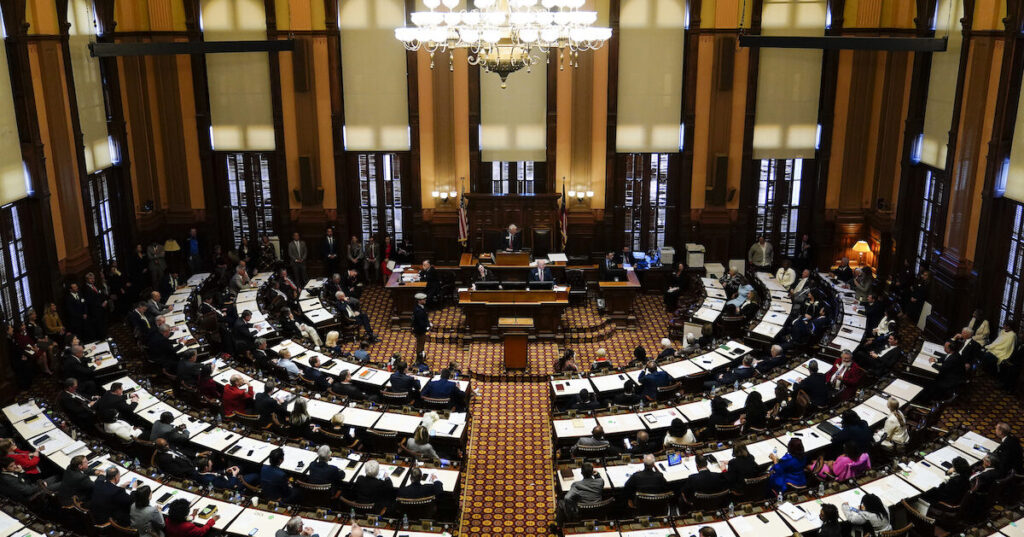
Last Friday marked Crossover Day in the Georgia legislative session, the point by which bills must clear their chamber of origin to remain viable. While legislation is never entirely “dead” and can still resurface as an amendment to another bill, it’s a good time to take inventory of where things stand under the Gold Dome with less than three weeks left in the session.
Tax policy has drawn plenty of attention this year, particularly a few proposals to cut or revise Georgia’s income and property taxes.
Heated debate over property taxes is nothing new in Georgia, and the House’s effort on that front did not make it through Crossover Day totally unscathed. Its original proposal to phase out property taxes on owner-occupied homes by 2032 required a constitutional amendment, a high bar that includes a two-thirds vote by lawmakers and ratification by Georgia voters.
After failing to muster two-thirds support for that ambitious proposal, the House instead passed a substitute version on Crossover Day that would limit growth in property tax revenue to the greater of 3% or the rate of inflation. The revised version of the bill also added a “Truth in Taxation” provision, which requires notification for all property owners when revenues will exceed the roll-back rate.
Income-tax reform efforts saw a wide range of bills and some notable passages. Senate Bills 476 and 477, both introduced by Sen. Blake Tillery (R-Vidalia), cleared the Senate last month. SB 476 would deduct $50,000 from single filers’ taxable income and $100,000 from joint filers’ taxable income, while repealing or sunsetting various tax credits to help pay for those cuts. Alternatively, SB 477 would lower the income tax rate to 4.99% for tax year 2026, and then to 4.49% in 2027 and 3.99% in 2028 if revenue conditions are met. The bills were introduced as separate options for reform.
The House also advanced a few income tax reforms of its own including House Bills 1000 and 1001 introduced by Rep. Matthew Gambill (R-Cartersville) and Rep. Will Wade (R-Dawsonville), respectively. HB 1000 would provide a one-time income tax rebate of $250 for single filers, $375 for heads of household and $500 for joint filers who filed returns for both 2024 and 2025. HB 1001 would lower the flat income tax rate from 5.19% to 4.99% retroactive to the start of 2026.
The House also passed House Bill 880, sponsored by Rep. Shaw Blackmon, which would reduce the state income tax by one-tenth of a percentage point each year until it reaches 3.99%. It accomplishes this by setting aside surplus state revenues for future tax relief.
Taxes aren’t the only way lawmakers tried to address the politically pertinent question of affordability. Each chamber saw efforts to address permitting delays, which have added to the cost of housing in Georgia. Senate Bill 447, sponsored by Sen. Clint Dixon (R-Gwinnett), would revise the review process for permits tied to site preparation for new housing by requiring clearer reasons for denials, imposing a 14-day turnaround for resubmissions and approving permits if local governments miss deadlines. While this bill passed its chamber, a similar bill in the House, House Bill 812, introduced by Rep. Mike Cheokas (R-Americus), did not.
In education, the Senate advanced a bill to create a Georgia Charter Schools Authority, which would function as a state-backed lender for charter school facilities projects since they often lack other access to public funding. Senate Bill 498, sponsored by Sen. Clint Dixon, is designed to expand access to low-interest revolving loans and other public financing tools for construction, renovation and rehabilitation.
The Senate advanced a follow-up to the Georgia Promise Scholarship law with the passage of Senate Bill 445, sponsored by Sen. Greg Dolezal (R-Cumming). Under current law, the Governor’s Office of Student Achievement produces a list of public schools that rank in the bottom 25% statewide; students zoned to attend these schools are eligible for the Promise Scholarship. This update specifies that the list should not include public schools with a statewide attendance zone or certain charter schools.
Finally, here are a few notable healthcare items. The Senate passed legislation that would establish a pathway for limited provisional licenses and eventual full licensure for certain internationally trained physicians, with hopes of addressing the state’s physician workforce shortage. This is Senate Bill 427, sponsored by Sen. Ben Watson (R-Savannah).
Senate Bill 367, sponsored by Sen. Bill Cowsert (R-Athens), also crossed over. This bill would create a new certificate of need exemption for facilities, services and equipment dedicated exclusively to cancer treatment. House Bill 1292, sponsored by Rep. Spencer Frye (D-Athens), proposed a CON exemption for nursing homes for war veterans, but it did not clear the House by Crossover Day.
Crossover Day narrows the field, and while this list of updates is not exhaustive, the next few weeks will determine which of these proposals ultimately make it to the governor’s desk.
More Commentary
Georgia won’t lower cost of housing until state tackles the ‘regulatory tax’
Major Education Bills Advance in Georgia Legislature as Session Nears End
The Fight Against Red Tape Continues in Georgia