
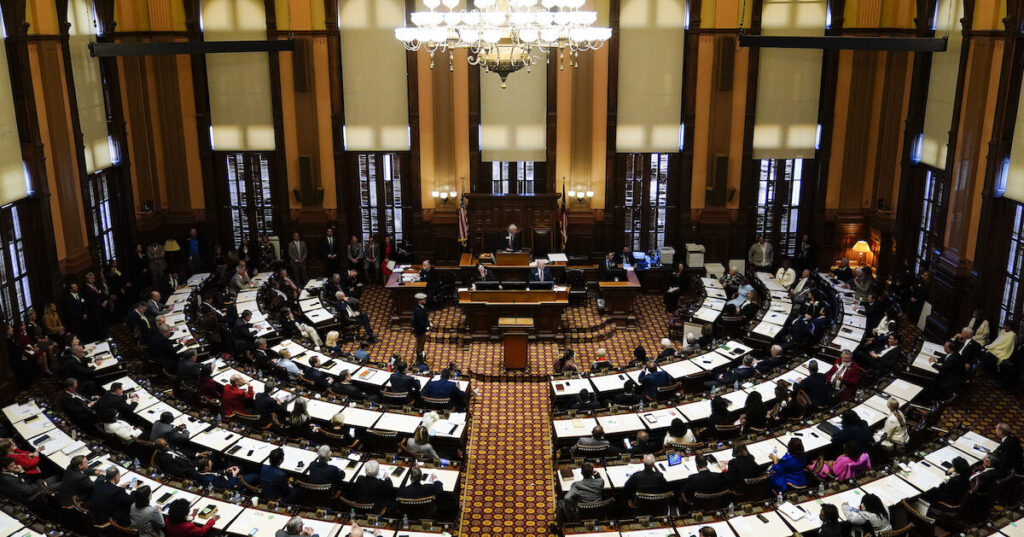
On Monday, the Appropriations Conference Committee met to begin working through the differences between the House and Senate mid-year budget plans. By Wednesday, both chambers had passed the $43.7 billion amended budget, which included funding for the state’s first new mental health hospital in more than 60 years and $150 million to add bed space at state prisons. It also included roughly $850 million for property tax relief and a $1.2 billion income tax rebate.
The House passed House Bill 1193, the Georgia Early Literacy Act, almost unanimously on Tuesday. This bill, sponsored by Rep. Chris Erwin, would expand statewide literacy efforts by providing for literacy coaches in every public school with early grades, requiring readiness assessments and kindergarten attendance before first grade, creating new literacy leadership positions and revising literacy screening and professional learning requirements. In another education policy effort, Tuesday also saw the passage of House Bill 1009, sponsored by Rep. Scott Hilton. This is an expansion of last year’s “Distraction-Free Education Act,” and extends restrictions on personal electronic devices such as cell phones in Georgia’s high schools.
The Senate Finance Committee passed Senate Bill 498, which seeks to establish the Georgia Charter School Facilities Authority to provide much needed low-interest revolving loans to assist charter schools with financing for capital projects.
The House Ways and Means Committee advanced Rep. Matthew Gambill’s House Bill 1000, which would provide one-time tax relief by issuing a credit to individual taxpayers based on income taxes paid in recent years. As with similar efforts in recent years, it is $250 for individuals and $500 for joint filers. The Ways and Means Committee also advanced House Resolution 1114, which is the accompanying constitutional amendment for the Georgia House’s property tax overhaul, paired with Rep. Shaw Blackmon’s House Bill 1116.
On Thursday, Senate Bill 367, sponsored by Sen. Bill Cowsert, advanced out of the Senate Regulated Industries Committee. The bill would eliminate certificate of need requirements for all services and facilities related to cancer care. House Bill 1292, sponsored by Rep. Spencer Frye, passed unanimously out of the House Health Committee on Tuesday. This bill creates a certificate of need exemption for certain veterans’ nursing facilities. Specifically, it exempts an intermediate care facility or skilled nursing facility that serves war veterans and is operated by the Georgia Department of Veterans Service, and it also says those beds would not count toward the state’s inventory when determining need for other providers or services.
The House Government Affairs Committee passed several measures aimed at increasing the supply of housing. House Bill 400, sponsored by Rep. Spencer Frye and known as the CHOICE Act, would create a system where local governments that adopt certain pro-housing policies receive priority consideration when applying for state grants and loans. It also passed House Bill 812, sponsored by Rep. Mike Cheokas, which seeks to tighten the 45-day approval process, provide clarity on the requirements for a complete application on the front end and reasons for denial on the back end. It also passed House Bill 1166, sponsored by Rep. Tangie Herring, which would allow homeowners to build tiny homes on their property without needing zoning approval if that home is smaller than 400 square feet.
The Senate Regulated Industries Committee also saw sharp debate over Senate Bill 34, introduced last year by Sen. Chuck Hufstetler. This bill seeks to prevent utilities from passing costs incurred by data centers onto smaller-scale consumers. After hearing testimony from the Public Service Commission, Georgia Power, consumer advocates and the data center industry, the committee adopted a substitute that codifies contract requirements between utilities and large-load customers but removes the explicit prohibition on cost shifting. The bill moved to the Senate floor on Thursday, but it did not receive a vote.
Lastly, next Friday is Crossover Day, the deadline for bills to pass their chamber of origin, so lawmakers will be busy trying to push their priorities across the finish line.