
The growth of the data center industry has been met with frequent criticism and political pushback, particularly due to its use of natural resources. One of those recurring criticisms concerns the amount of water that data centers use in their cooling systems.
Communities considering these facilities should want to know whether their arrival will strain local supplies or compete with existing users, especially in times of scarcity like during a drought. However, it’s just as important to have an accurate picture of how much data centers consume. Transparency and locally determined parameters for water usage are key to ensuring data centers are responsible, trustworthy neighbors.
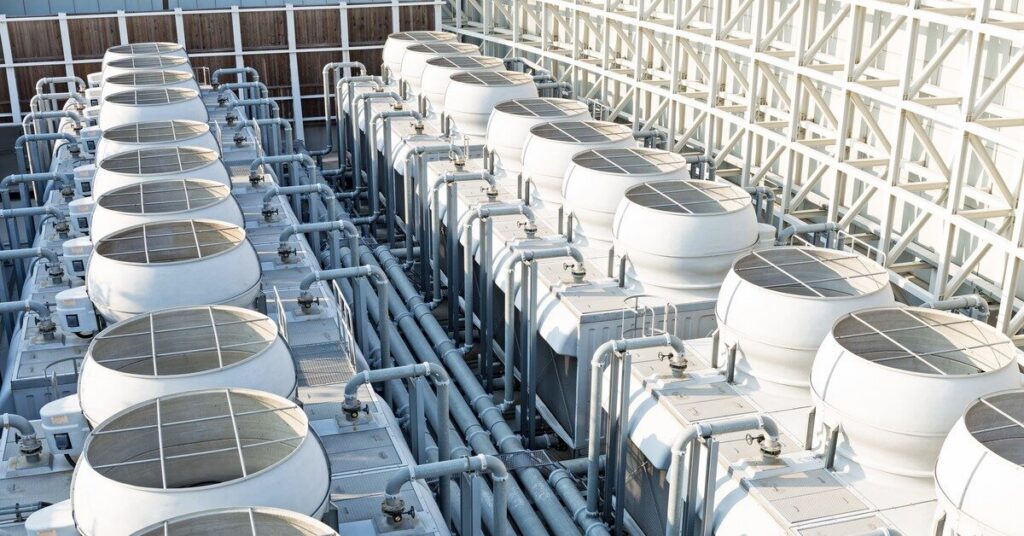
In reality, water requirements for data centers can differ substantially. The computers inside a data center, similar to a personal computer but on a larger scale, generate heat as they store and process information. Water helps absorb the heat to prevent equipment from overheating. For example, some cooling systems use fans to move warm air across metal coils containing chilled water, which absorbs heat and carries it away. Others circulate cooling liquid through channels in metal plates attached directly to computer chips, collecting heat closer to its source. The amount of water a facility needs depends both on the facility’s size and how its cooling system works.
A key distinction is whether a data center uses evaporation to remove heat. In evaporative systems, water absorbs heat and some evaporates, requiring a continuing supply to replace it. Other systems circulate fluid through sealed loops and transfer the heat to outside air without evaporation, greatly reducing water needs.
Projects across Georgia illustrate a wide range of water usage. Microsoft estimates that its proposed Tyrone facility would use approximately 4,000 gallons of water per day once operational. For reference, a typical sit-down restaurant uses between 3,000 and 7,000 gallons daily. A compilation of development proposals submitted to the Southern Georgia Regional Commission by the Georgia Water Coalition, a statewide water-conservation advocacy group, lists daily water demand of 42,000 gallons for T5’s Lithia Springs project and 570,000 gallons for QTS’s Fayetteville campus. These projects obviously differ in size and design, and one facility’s requirements should not be treated as representative of the industry. However, the T5 and QTS data centers’ water usage puts them on similar levels as hotels and factories, respectively, which rarely draw the same kind of scrutiny for their usage of resources.
It’s also worth remembering that water in these cases is not necessarily all consumed. Some may be treated and returned to the original watershed, while water lost through evaporation is unavailable for immediate reuse. A facility’s total demand and its consumptive use therefore answer different questions.
It may also be useful to assess data centers in context with other operations that depend on water. Project Arrowhead, a proposed 1,205-acre data center campus in Irwin County, would include 18 buildings totalling 4.22 million square feet. In comments about the project, the Georgia Water Coalition estimated that an 80-acre irrigated field consumes about 26 million gallons annually. The campus’s projected annual consumption at full buildout is 7.3 million gallons. That would put its consumption at a little over one quarter of the hypothetical field’s estimated total, despite occupying a site roughly 15 times as large.
For more perspective, we can look outside of Georgia. Virginia’s legislative audit agency found that most data center buildings in its study used no more water than an average large office building. That benchmark was 6.7 million gallons annually, roughly 18,400 gallons per day, but some facilities used substantially more.
Virginia’s data centers used an estimated 2.1 billion gallons in 2023, with slightly more than one-third supplied by reclaimed wastewater. The audit placed data center water use at less than 0.5% of statewide withdrawals. Within individual water providers’ service areas, however, data centers accounted for between 0.2% and 21% of water use across the six systems studied, excluding reclaimed water. These figures show how much water these data centers used, but do not distinguish between water that was returned after use and water lost to evaporation or otherwise not returned to the original source.
The idea that data centers are a uniquely harmful strain on water supply does not hold up in comparison to other industries. However, data center facilities can still be substantial customers for the local systems serving them. A practical question for communities is how a proposed project fits alongside existing needs.
For a host community, the effect depends on where the water comes from, when it is needed and how much returns to the same water source after use. Annual averages can obscure seasonal pressures, particularly when hot weather increases cooling needs while drought reduces available supplies.
The arrival of data centers does not, by itself, signal an impending resource shortage or environmental crisis. Understanding their impact requires knowing how much water a facility expects to use during ordinary operations and periods of peak demand, whether that water comes from drinking-water supplies or reclaimed wastewater, and how much returns to the same watershed after use.
Facts like these provide a more useful basis for evaluating a project than treating data centers as uniformly water-intensive or assuming that a large gallons-per-day figure necessarily represents an unsustainable burden. Local governments and water utilities already assess water demand and infrastructure capacity when reviewing other development proposals, and data centers warrant the same scrutiny and transparency.
One of the most effective prospects for managing these effects over time is continued innovation and investment in technology. More efficient cooling systems and equipment can reduce the resources required, and operators have a financial incentive to pursue those improvements because water and electricity are operating expenses. As technologies become more affordable and practical, more facilities can adopt them. Any assessment of data centers’ long-term impact should account for that potential for improvement alongside projections of growth.

More Commentary
The Lesson Nikole Hannah-Jones Didn’t Mean to Teach
You’ve Already Used a Data Center Today
What I Tell My Children About 9/11