
Data centers remain one of the most contentious political topics of the year, and much of the policy discussion around their construction has shifted from attracting them to managing their growth.
Part of that shift is because policymakers and industry leaders are coming to better understand how data centers affect economies, electrical systems and natural resources.
However, they are also responding to growing public concern about whether communities benefit from having them nearby.
In this week’s commentary, we take a look at what data centers actually provide — and why most of us already depend on them without realizing it.
– Kyle Wingfield
Friday’s Freshest 🗞️

Georgia has averaged roughly a million new residents per decade, drawn by an economy that rewards showing up and doing the work, but what a paycheck is worth isn’t set by the employer alone. Here are five key questions that show where Georgia still has room to improve.
Arkansas billed its Medicaid expansion as the conservative alternative, using federal dollars to buy private insurance for able-bodied adults instead of enrolling them in traditional Medicaid. But the experiment produced steep cost overruns and no improvement in the state’s health outcomes.
Most people are probably aware that where they receive their healthcare affects the price. But perhaps less intuitive is that the payment can change depending on who owns the healthcare facility.
In 1955, Milton Friedman drew a distinction that might sound obvious today but was radical then — A government’s role in financing education does not require a government monopoly on running schools.
Peach Picks 🍑

The U.S. Census Bureau announced that real median household income was $87,460 in 2025, the highest on record dating back to 1967. The official poverty rate fell 0.5 percentage points to 10.2% in 2025.
Georgia’s unemployment rate declined to 3.2% in August as the labor force reached an all-time high, according to the Georgia Department of Labor. The unemployment rate in July was 3.3%. It was 3.4% a year ago. The national unemployment rate is 4.1%.
It took five months to find a successor to University System of Georgia Chancellor Sonny Perdue, and after looking far and wide the Board of Regents picked someone close to home. Thomas A. Fanning, the new university system leader, already has a building named after him at Georgia Tech and served on the Tech Foundation board.
The activists who spent a generation fighting nuclear power, then carbon emissions, have moved on to a new apocalypse: artificial intelligence. Georgia is the counterexample, where Georgia Power finished Vogtle 3 and 4 — the first new reactors in a generation — and several Public Service Commissioners lost their seats over the cost overruns so the country could relearn how to build.
The federal Environmental Protection Agency has rolled back rules restricting climate warming emissions at electrical power plants, including those in Georgia. The rules the EPA ended this week date from the Biden administration and would have required coal and natural gas-fired power plants to restrict carbon emissions starting in 2030.
Featured Report 📊

As Georgia decides whether to renominate its Opportunity Zones or pick new ones, a Keystone Strategy analysis in partnership with the Foundation suggests sticking with what’s already working ways off more than starting over.
Quote of the Week 🌟
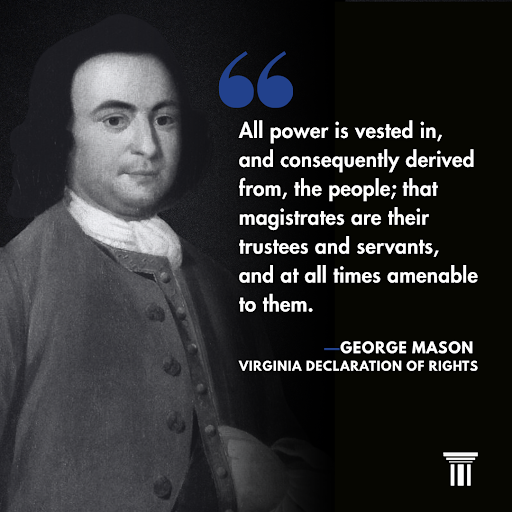
George Mason’s words capture a foundational principle of American government: Political power does not belong to government itself, but to the people.
Public officials exercise authority only because citizens have entrusted them with it. That makes government a stewardship, not an entitlement.
Mason’s reminder that officials are “trustees and servants” also underscores the importance of accountability. Elections, constitutional limits and transparent institutions all help ensure that those in power remain answerable to the people they serve.
Nearly 250 years later, the principle remains essential: government is strongest when it remembers where its authority comes from and whom it exists to serve.
More Commentary
You’ve Already Used a Data Center Today
What I Tell My Children About 9/11
5 Questions for This Labor Day in Georgia