
July 31 marks 114 years since the birth of Milton Friedman, the University of Chicago economist whose ideas reshaped monetary policy, helped end the military draft and earned him the Nobel Prize in economics. Yet for all those achievements, the idea likely to touch the most American lives is one he sketched in a short 1955 essay: that parents, not the government, should decide where their children go to school.
In “The Role of Government in Education,” Friedman drew a distinction that might sound obvious today but was radical then: A government’s role in financing education does not require a government monopoly on running schools. Society benefits when every child is educated; Friedman called these spillover benefits “neighborhood effects.” And while that may justify public funding, it does not justify limiting a child’s educational options to the nearest public school.
His alternative was disarmingly simple: Provide families with vouchers “redeemable for a specified maximum sum per child per year” at any school meeting minimum standards, whether public or private. Let families choose — and let schools compete for students the way businesses compete for customers with all the quality and innovation that competition reliably produces in other fields.
We take a look at Milton Friedman’s role in the history of school choice in this week’s commentary.
– Kyle Wingfield
Friday’s Freshest 🗞️

Restrictive licensing practices and regulatory barriers frequently prevent qualified and trained workers from participating in the workforce. This is true in Georgia as elsewhere, but a few bills passed in this year’s legislative session took aim at those barriers.
Congress recently passed a bill to tackle housing affordability. But despite the bill’s overwhelming bipartisan support, legitimate concerns remain about how much it will actually move the needle.
Rising insurance premiums for home and auto have long been attributed to the cost of Georgia’s legal landscape. For years, those bills kept climbing, and Georgia frequently ranked among the worst states for lawsuit abuse and excessive tort costs—until lawmakers decided to act.
The Declaration of Independence was the most revolutionary act of our revolutionary generation. Not because the document’s signers risked everything by doing so, though they did. Not because it opened a new epoch, though it did. But rather, because it sparked a change in human thought, behavior and expectations that continues to unfold 250 years later.
Peach Picks 🍑

Georgia data centers consume so much electricity that they could generate millions in utility franchise fees for counties and serve as a gateway to lower property taxes, if a state law is changed, according to county officials. Franchise fees are a rental of a right-of-way paid to cities by utility companies in Georgia.
Lottery revenues for Georgia preschools and the HOPE Scholarship rebounded this past fiscal year after recent dips sparked some alarms over possible future shortfalls for key state-funded education programs. Ticket sales for the fiscal year that ended July 1 netted roughly $1.54 billion in proceeds for preschools and scholarships, topping last year’s collections by 5% and trailing only 2021 for the highest revenue haul since the Lottery’s creation in 1992.
Gov. Brian Kemp weighed in on the rush to develop artificial intelligence, calling the technology “scary” while also welcoming data centers to Georgia and criticizing others who would pause their development. “I’m not saying we need a data center in every community that’s out there, but to have a moratorium just like the governor of New York did and what Keisha Lance Bottoms is proposing — to me, is irresponsible,” Kemp said in a video interview with POLITICO Energy published Monday.
Fresh off the world stage with the departure of FIFA World Cup fans, Georgia is back in the limelight with the listing of the Okefenokee Swamp as an international treasure. The United Nations Educational, Scientific and Cultural Organization announced Saturday that it had decided to add the Okefenokee National Wildlife Refuge to its World Heritage Site List.
In the Media 📺
Foundation Policy Analyst J. Thomas Perdue spoke with Fortune about Georgia’s data center tax exemptions amid Georgia Power’s 1,000-mile grid expansion. Noting that “the policy direction has clearly shifted,” Perdue explained that state and local governments bear the immediate cost of the exemptions through uncollected revenue—and that whether Georgians ultimately feel it through other taxes or reduced spending depends on subsequent budget decisions.
Featured Video 🎥
In this video, the Georgia Public Policy Foundation examines housing data across metro Atlanta to better understand the role of institutional investors in the housing market. While large investors do participate in the market and receive significant attention in the media, the data reveals a more complicated story.
Quote of the Week 🌟
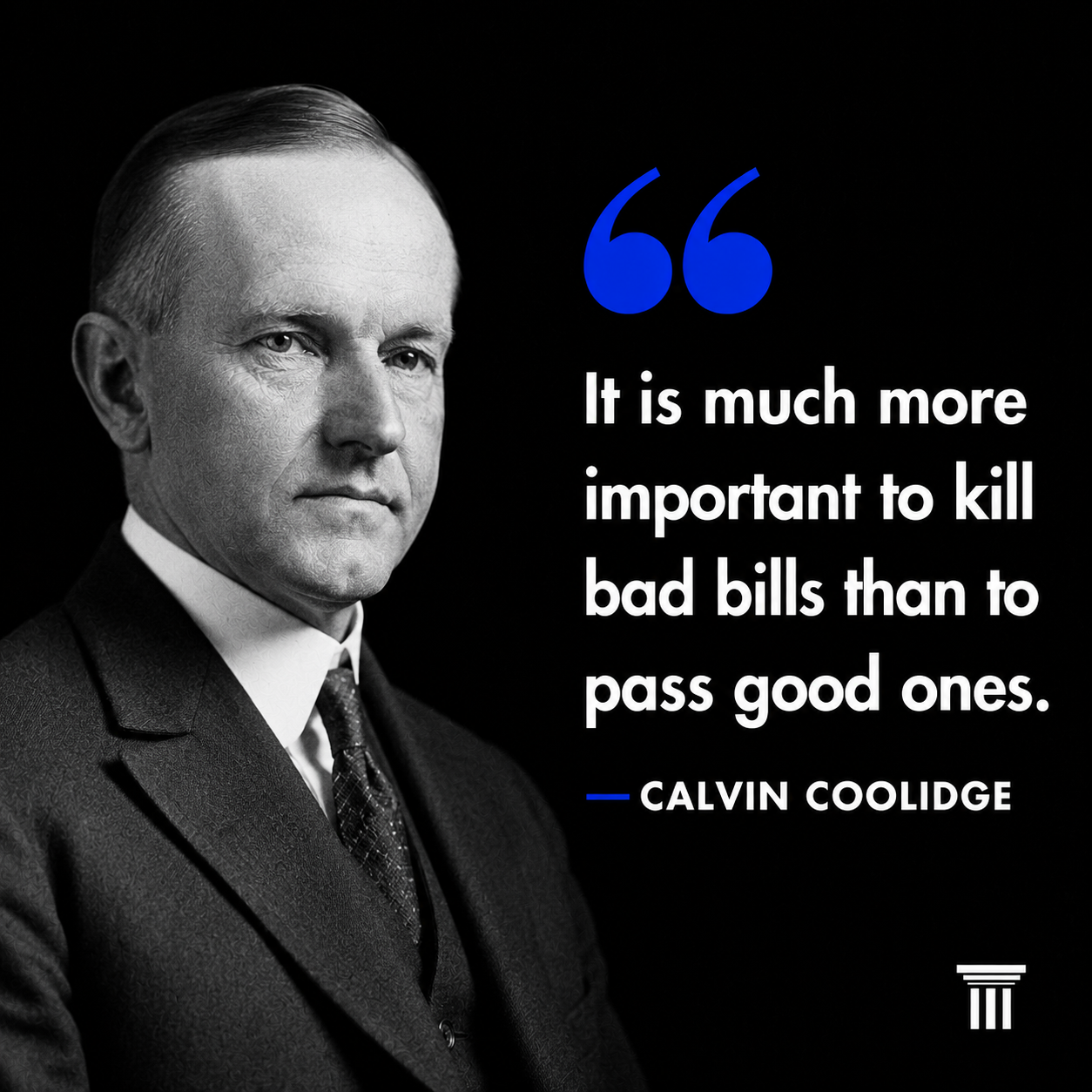
Calvin Coolidge’s observation captures an often-overlooked truth about government: Progress is not measured only by how many laws are enacted. Legislatures can do public service by stopping proposals that would create unintended costs, restrict freedom or expand government without solving the underlying problem.
Every bill carries trade-offs. Even well-intentioned policies can impose burdens on families, businesses and local communities. That is why scrutiny matters. Lawmakers should ask whether a proposal is necessary, whether it respects constitutional limits and whether its benefits justify its costs.
Coolidge’s point is relevant today, when political success is often defined by producing more legislation. Sometimes the wiser course is restraint. Preventing a harmful law can protect taxpayers, preserve opportunity and avoid years of difficult correction.
Good government requires judgment, not just activity. The goal should be better policy, not simply more policy, and sometimes the best legislative achievement is the bill that never becomes law.
More Commentary
Guide to the Issues: 2026: Thirty years after the first edition
The Lesson Nikole Hannah-Jones Didn’t Mean to Teach
You’ve Already Used a Data Center Today