
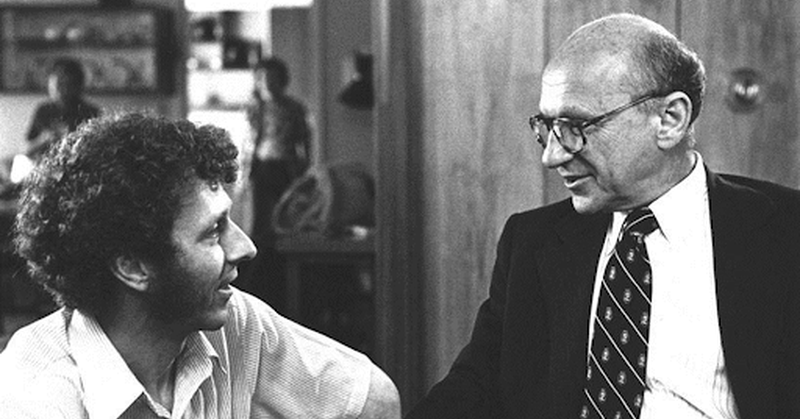
July 31 marks 114 years since the birth of Milton Friedman, the University of Chicago economist whose ideas reshaped monetary policy, helped end the military draft and earned him the Nobel Prize in economics. Yet for all those achievements, the idea likely to touch the most American lives is one he sketched in a short 1955 essay: that parents, not the government, should decide where their children go to school.
In “The Role of Government in Education,” Friedman drew a distinction that might sound obvious today but was radical then: A government’s role in financing education does not require a government monopoly on running schools. Society benefits when every child is educated; Friedman called these spillover benefits “neighborhood effects.” And while that may justify public funding, it does not justify limiting a child’s educational options to the nearest public school.
His alternative was disarmingly simple: Provide families with vouchers “redeemable for a specified maximum sum per child per year” at any school meeting minimum standards, whether public or private. Let families choose — and let schools compete for students the way businesses compete for customers with all the quality and innovation that competition reliably produces in other fields.
For decades, the proposal remained a thought experiment. Friedman refined it in “Capitalism and Freedom” in 1962, and he and his wife Rose carried it into millions of living rooms with the “Free to Choose” book and PBS series in 1980. Despite this, the education establishment continued to dismiss vouchers as a fringe fantasy, and the political coalition needed to pass them did not exist.
The breakthrough came from an unexpected alliance. In 1990, Wisconsin state Rep. Annette “Polly” Williams, a Milwaukee Democrat who had chaired Jesse Jackson’s presidential campaigns in her state, joined Republican Gov. Tommy Thompson to create the Milwaukee Parental Choice Program. Williams was frustrated that low-income families were trapped in failing schools that wealthier families could simply move away from, and she saw choice as empowerment. The program launched with roughly 340 students in seven private schools, making it America’s first modern private school choice program.
Cleveland followed in 1995, and its program, which included religious schools, soon drew a constitutional challenge. In Zelman v. Simmons-Harris (2002), the U.S. Supreme Court settled the question, holding that public aid flowing to schools through the genuine, independent choices of parents does not violate the First Amendment. The legal cloud lifted, and the movement began to diversify.
Arizona pioneered tax-credit scholarships in 1997, and Georgia adopted that model in 2008 with its Qualified Education Expense Tax Credit. In 2011, Arizona innovated again with the education savings account, a flexible instrument that funds tuition, tutoring, therapy, curriculum and more. Georgia adopted a similar program in 2024 for children residing in schools which are in the bottom 25% of the state.
The Friedmans, for their part, devoted their final years to the cause, founding what is now EdChoice in 1996 to advance educational freedom. When Milton Friedman died in 2006 at age 94, only about 100,000 students nationwide were using private school choice, almost all in programs that were small, capped and narrowly targeted.
Friedman always insisted those programs were a beginning: a means of transitioning from a government monopoly to a competitive education marketplace open to every family. That transition arrived faster than almost anyone predicted. West Virginia enacted the first universal education choice program in 2021. Arizona made its ESA universal in 2022, and Iowa, Utah, Arkansas, Florida, Tennessee and Texas soon followed. Today, 34 states offer some form of private school choice, 18 of them open to virtually every K-12 student. More than 1.5 million students now use these programs, fifteen times the number at Friedman’s death. Congress joined last summer, creating a federal scholarship tax credit modeled on state programs like Georgia’s and set to launch this coming January.
Georgia’s story runs somewhat parallel to the nation’s. The state created a special-needs scholarship in 2007 and the tax-credit scholarship a year later. Then, in 2024, the General Assembly passed the Georgia Promise Scholarship Act, the state’s first education savings account, offering families zoned to the lowest-performing quartile of public schools up to $6,500 a year for tuition, tutoring and other approved expenses. More than 7,600 students used the scholarship in its first year. And this January, Gov. Brian Kemp opted Georgia into the new federal scholarship tax credit, ensuring Georgia families will benefit the moment it takes effect in 2027. Even so, Georgia is not yet a universal-choice state and still has significant obstacles to overcome.
Friedman himself did not live to see a single state adopt universal choice. Toward the end of his life, he lamented that progress had been “distressingly slow.” Yet he understood better than anyone how ideas win and spent half a century making sure this one was within reach.
So the best tribute to Friedman on his birthday is a parent choosing the school that best fits her child — exercising a freedom that a Chicago economist imagined more than seven decades ago.

More Commentary
New Laws Ease Georgia’s Occupational Licensing Burden
Congress Passed a Bipartisan Housing Bill, but Homeownership Challenges Remain
Are Georgia’s Tort Reforms Starting to Pay Off?