
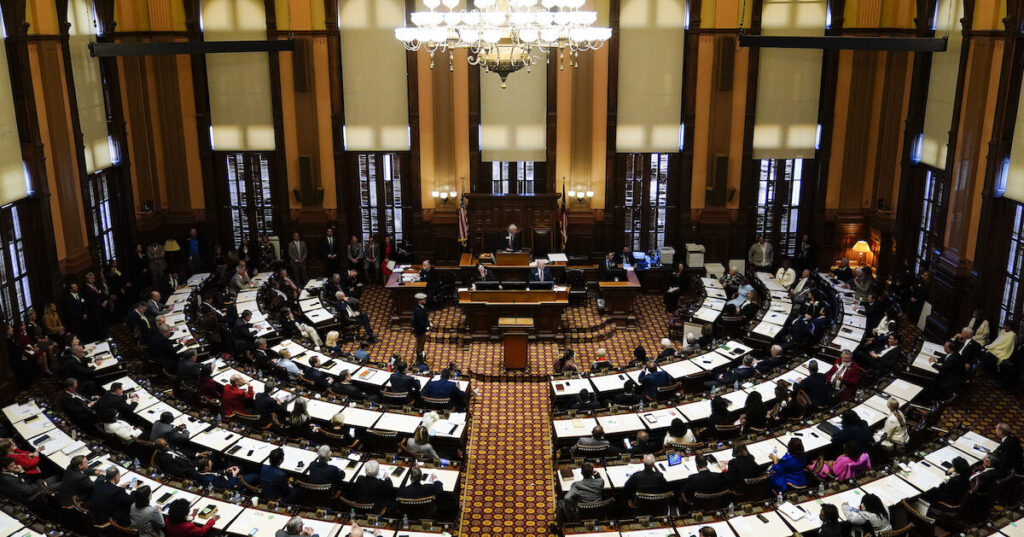
In addition to this week being a day shorter as the nation celebrated Martin Luther King Day, the pace under the Gold Dome shifted as lawmakers turned their attention to the traditional “budget week.”
Both chambers held joint hearings on Governor Kemp’s proposed amended FY 2026 budget and the FY 2027 spending plan, which included state agency presentations and requests. Those hearings set the stage for future negotiations over tax relief, education funding, infrastructure spending and the state’s reserve balance.
One notable element of this year’s budget is Georgia’s return to issuing general obligation bonds, marking the first time in three years the state has leaned on debt financing after a period of pay-as-you-go spending which was sustained by an unprecedented surplus.
Even with budget work dominating the calendar, several policy conversations continued to take shape.
Lawmakers continue to debate tort reform issues that dominated much of last year’s session. Bills like HB 902, sponsored by Representative Todd Jones, serves as a follow-up to those changes, focusing on insurance transparency and data collection as legislators assess whether tort reform is delivering on promises to lower costs.
Two bills were introduced in the Senate to address tax exemptions for Georgia’s data centers. SB 410, sponsored by Senator Matt Brass, would prohibit any new tax exemptions for data centers while allowing those already approved to remain in place. SB 408, introduced by Senator Nan Orrock, would end the tax exemptions in 2027, five years earlier than their original sunset date.
In education policy, lawmakers are once again engaging with school finance and student environment issues. HB 987, also sponsored by Rep. Todd Jones, revisits elements of the state’s equalization grant system, which is designed to help level funding disparities among school districts.
An expansion of last year’s “Distraction-Free Education Act” was listed as a priority by House Speaker Jon Burns last week, and that has now been proposed as HB 1009. This bill, sponsored by Representative Scott Hilton, extends restrictions on personal electronic devices into Georgia’s high schools.
Tax policy also remained front and center, with the introduction of House Bills 1000 and 1001, two priorities highlighted in Gov. Kemp’s State of the State address. HB 1000, sponsored by Representative Matthew Gambill, would provide one-time tax relief by issuing a credit to individual taxpayers based on income taxes paid in recent years, and HB 1001, sponsored by Representative Will Wade, would lower Georgia’s income tax rate to 5.19% to 4.99%.
While most of these bills are still early in the process, their introduction signals where policy debates are likely to accelerate moving forward.

More Commentary
The Three Constitutional Amendments on Georgia’s 2026 Ballot
To Tackle Affordability, Georgia’s Next Governor Should Start With Cutting Red Tape
Guide to the Issues 2026: Thirty years after the first edition